
A Proposal to Revive Small Cardano Stake Pools and Strengthen Decentralization
A community-focused proposal to help small Cardano stake pools survive, gain visibility, produce blocks, and strengthen the long-term decentralization of the Cardano ecosystem.
Small pools are closing because they cannot reach consistent block production.
Older support paths helped until 2025, but capacity is limited.
Blockiy proposes a faster, free, and more visible support model.
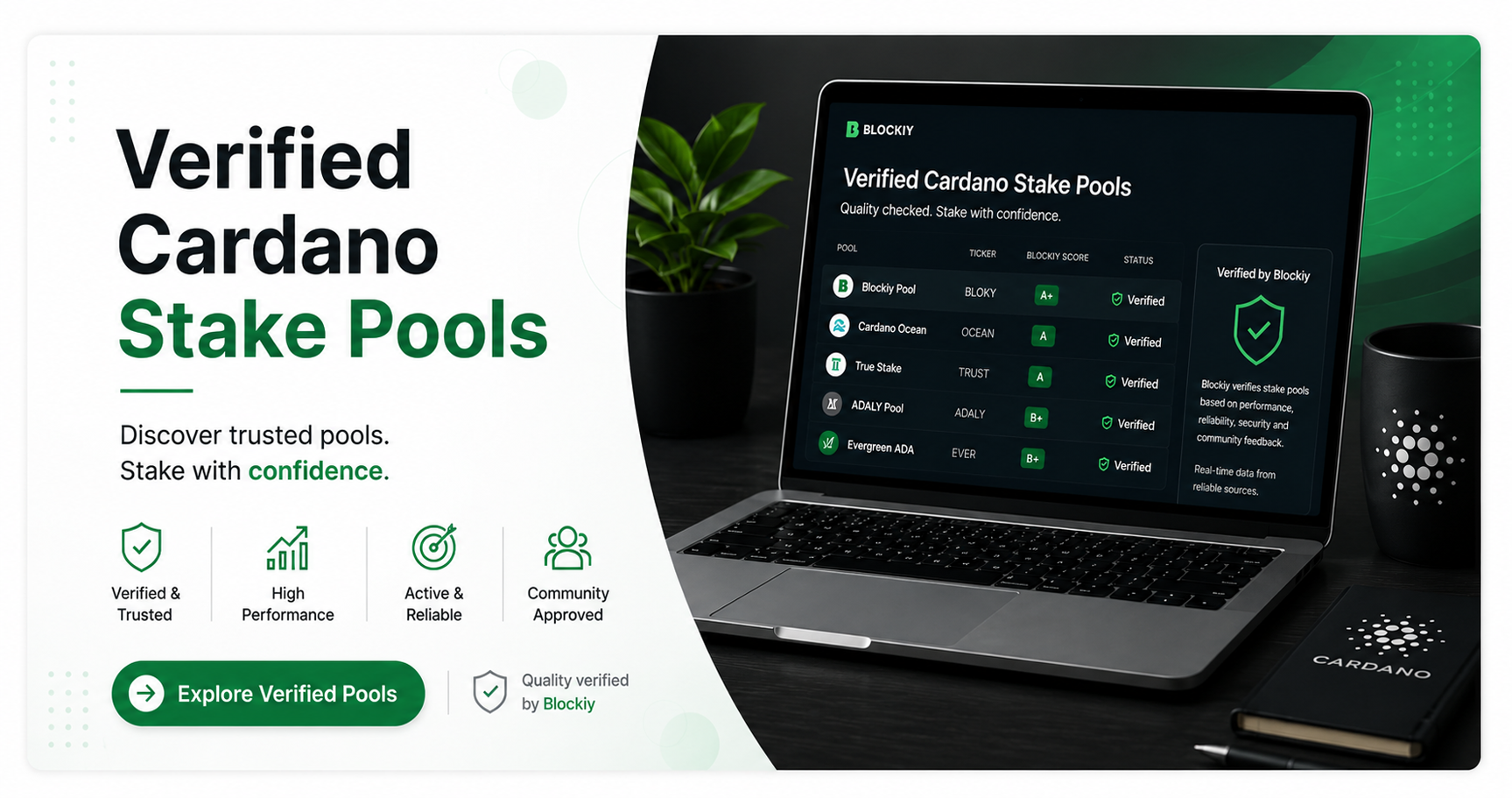
The Cardano Foundation and ecosystem programs can use Blockiy's verified list to identify quality small pools.
Cardano was built around a simple but powerful vision: a decentralized blockchain secured by thousands of independent operators around the world.
Unlike traditional financial systems, Cardano's security model depends on participation from individuals, small teams, educators, developers, community builders, and entrepreneurs who operate stake pools and contribute to the network.
But there is a growing problem that deserves attention. Every year, dozens — if not hundreds — of small stake pools quietly disappear.
- Many small Cardano pools fail before they get a fair chance to prove their infrastructure.
- The main problem is often low delegated stake, not poor technical operation.
- Older support solutions helped until 2025, but they cannot cover every promising small pool.
- Blockiy introduces a new, free, and faster support layer based on verification, visibility, and cooperation.
The Hidden Crisis Facing Small Stake Pools
Many ADA holders see thousands of pools listed on explorers and assume Cardano's decentralization is thriving. The reality is more complicated.
Every month, new operators launch stake pools. Many invest time, money, infrastructure, education, and community-building effort. They purchase servers, maintain relays, monitor nodes, follow upgrades, and contribute to the ecosystem.
Yet most never produce enough blocks to become sustainable. For many operators, the first year becomes a constant struggle between infrastructure costs and the hope of attracting enough delegation to survive.
Why Small Pools Fail
The issue is rarely technical. Most small pools operate correctly. Their nodes are synchronized, their servers are online, and their infrastructure is secure.
The problem is mathematical. Cardano's Ouroboros protocol assigns block opportunities based on delegated stake. A pool with 50 million ADA has dramatically higher chances of producing blocks than a pool with 200,000 ADA.
- No delegation
- No blocks
- No reward history
- No visibility
- No new delegators
- Eventually, no pool
Many talented operators never fail because they are bad operators. They fail because they never receive a realistic opportunity to demonstrate their capabilities.
Why This Matters to Cardano
Every independent operator who leaves the ecosystem reduces infrastructure diversity, geographic diversity, community participation, network resilience, and long-term decentralization.
Cardano does not become stronger when small pools disappear. It becomes more dependent on larger operators. While large pools are important and provide excellent service, a healthy ecosystem requires both large and small participants.
Existing Solutions That Helped Until 2025
The Cardano community has already created several important initiatives that supported smaller operators and improved decentralization. These solutions were valuable, especially in earlier phases of Cardano staking.
However, by 2025 the challenge became clearer: the number of small pools seeking support was much larger than the number of pools that could realistically receive direct help.
SPA helped highlight the importance of independent operators and the role single pools play in preserving decentralization.
xSPO supported collaboration between independent stake pool operators, helping small pools gain visibility and community support.
The Foundation delegation program provided valuable temporary delegations that helped selected pools establish performance history.
These initiatives remain valuable, but they are not enough on their own. Many promising pools still fall through the gaps because support capacity is limited and discovery remains difficult.
A New Community Proposal: BLOCKIY
Instead of waiting for small pools to disappear, Blockiy proposes a faster and more practical approach: identify promising small pools early, verify their quality, make them visible, and help them receive support before they shut down.
Blockiy is not a stake pool, not a delegation service, and not a commercial platform. Its goal is to become a community-driven infrastructure layer dedicated to helping small Cardano stake pools survive long enough to prove their value.
The idea is simple and user-friendly: small pool operators register for free, Blockiy reviews pool quality, and a structured list of verified small pools can be used by delegators, community initiatives, and even the Cardano Foundation when evaluating future support candidates.
Most importantly, all services are completely free.
Building a Verified Small Pool Registry
The first challenge facing delegators and organizations is trust. Thousands of pools exist, but it is not always easy to know which ones are active, reliable, transparent, and genuinely contributing to Cardano.
Blockiy proposes creating a curated registry of small stake pools. Each registered pool would be reviewed based on infrastructure health, pool uptime, security practices, community activity, ecosystem contribution, and transparency.
The goal is not to rank pools. The goal is to identify quality operators who deserve visibility.
Creating a Resource for Ecosystem Support Programs
A verified registry could provide value far beyond individual delegators. Organizations such as the Cardano Foundation, community delegation programs, ecosystem funds, and decentralization initiatives could use this information when evaluating future support candidates.
Instead of searching manually across thousands of pools, they would have access to a structured list of active and verified operators. This could significantly improve the efficiency of future delegation initiatives.
Helping Pools Reach Their First Blocks Faster
One of the most difficult milestones for any operator is producing the first block. Without blocks, there is no history, little visibility, and delegators hesitate.
This creates the well-known bootstrap problem. To address this challenge, Blockiy is developing a community-based support model designed specifically for small pools.
The goal is speed and clarity: help good operators become visible faster, create trust faster, and move toward their first blocks faster.
The Blockiy Pool Support System
Groups of small stake pools voluntarily participate in a coordinated support network. Pools are organized into small teams, and during designated epochs, participating operators support one pool within the group.
The support rotates from pool to pool over time. The objective is not permanent delegation. The objective is helping pools produce blocks, build performance history, gain visibility, and attract organic delegation.
Instead of competing against one another, operators work together to increase the likelihood of success for everyone involved.
Register Your PoolWhy This Approach Is Different
Most existing support systems depend on a limited pool of external delegations. Blockiy focuses on faster discovery, verified visibility, and cooperation between small operators themselves.
| Older Support Paths | Blockiy Support Model |
|---|---|
| Helpful, but limited in capacity | Designed to create a broader verified list of quality small pools |
| Only a small number of pools may receive direct support | Gives more small operators visibility and a clearer entry point |
| Discovery can be slow and manual | Blockiy makes discovery faster through registration and review |
| Support often depends on external delegation only | Combines verification, visibility, cooperation, and community support |
The philosophy is simple: a stronger small-pool ecosystem benefits everyone. When more operators survive, decentralization improves, innovation increases, communities grow, geographic diversity expands, and Cardano becomes more resilient.
Why Participation Is Free
One of the biggest barriers facing small pools is cost. Many operators already spend hundreds or thousands of dollars per year maintaining infrastructure. Adding additional fees would only worsen the problem.
A Call to the Cardano Community
Cardano's success has never depended solely on technology. Its strength comes from its community.
If the ecosystem wants to preserve decentralization for the next decade, supporting small stake pools cannot remain an afterthought. We need systems that identify talented operators before they disappear, improve visibility for quality pools, and encourage collaboration instead of isolation.
Final Thoughts
Small stake pools are not merely service providers. They are educators, developers, community builders, and contributors who help shape the future of Cardano. Yet many leave the ecosystem before they ever have a realistic opportunity to succeed.
Blockiy is an open proposal aimed at addressing this challenge through free pool verification, community-driven visibility, collaboration, and innovative support mechanisms designed specifically for independent operators.
Whether through Foundation delegations, community initiatives, alliances such as xSPO and SPA, or new models like Blockiy, the goal remains the same: a stronger, healthier, and more decentralized Cardano ecosystem where talented operators are given a fair chance to succeed.
If you operate a small Cardano stake pool and want to participate in a free support system designed for independent operators, you can register your pool through your Blockiy account.
Register Your Pool Now