Already Staking ADA? Your Pool Choice Could Unlock More Than ADA
If your ADA is already staked, your wallet may make it feel as though the decision is finished. The pool name sits in a tab, rewards arrive when they arrive, and there is little reason to open the staking screen again.
But delegating is an ongoing choice. Pools differ in performance, fees, size, transparency, and what they offer their communities. In some cases, a pool also runs a separate token incentive for eligible delegators. That does not automatically make it a better pool; it gives you another factor to evaluate.
This guide is for people who already stake ADA and want to make a better decision with the ADA they have. We will look at what to measure, what happens when you switch pools, and how to assess Blockiy’s NIGHT, SNEK, and HOSKY airdrops without mistaking projected token quantities for guaranteed income.
Start with what your current pool is actually doing
The most useful question is not “Did I get a reward this epoch?” It is “Has this pool been a good home for my ADA over a meaningful period?” A small pool can produce no block in one epoch and have a strong run later. A large pool can look steady until it becomes saturated or its operator changes fees. One screenshot rarely tells the whole story.
Open your wallet or a Cardano pool explorer and note:
| What to check | Why it matters | A common mistake |
|---|---|---|
| Recent and longer-term block history | Shows whether the pool has generally produced the blocks expected for its size | Treating one empty epoch as proof the server is broken |
| Active stake and saturation | Influences block opportunities and whether rewards per ADA may decline near saturation | Looking only at live stake without considering the snapshot delay |
| Fixed cost and margin | Affect how the pool’s rewards are split between operator and delegators | Assuming a zero margin means zero operator fees |
| Pledge | Shows the owner’s declared stake commitment | Assuming a very large pledge guarantees rewards |
| Operator communication and uptime | Helps you judge how the operator handles incidents and upgrades | Relying only on a headline return figure |
| Any extra reward program | May add separate token eligibility | Counting a calculator estimate as money already earned |
You can do this check once every few months, or when a fee, performance pattern or your own goals change. Constantly switching after a single disappointing epoch is rarely a good way to judge a probabilistic system.
What you earn from ordinary ADA staking
Cardano selects stake pools for block production according to their share of active stake and a random process. When a pool earns rewards, its declared fixed cost and margin are taken according to the protocol, and the remaining ADA is distributed among its delegators. Your actual rewards can vary with pool performance, fees, network conditions and the amount of ADA you have delegated.
Delegation is non-custodial: choosing a pool does not transfer your ADA to its operator. Your ADA stays in your wallet and remains spendable. You can choose a different pool without asking the current operator for permission. Changing pools requires a normal on-chain delegation transaction and its network fee, but redelegating an already registered stake key does not ordinarily create a new first-time stake-key deposit.
These are the network’s ADA rewards. A pool’s optional token promotion is a different system, with its own eligibility rules, checks and payment schedule.
How to compare two pools without being fooled by one number
Imagine that Pool A has a higher displayed historical return than Pool B. That does not settle the choice. The figures may cover different time periods, luck can distort a short sample, and Pool A’s future stake or fee settings may differ from its past. Start with the time window behind any return number. Then inspect block performance, the pool’s stake, saturation, fees and operator communication.
Fees deserve a little care. Cardano’s current minimum declared fixed pool cost is 170 ADA, taken from the pool’s rewards in a rewarded epoch before the remaining rewards are divided. It is not charged directly to every delegator’s wallet, and it is not 170 ADA for each individual staker. The margin is a percentage of the reward left after that fixed cost. For a small pool, the fixed fee can represent a larger share of a small reward pot. For a larger pool, the same fixed fee is spread across more delegated stake.
Performance is just as important. A low-fee pool that repeatedly misses blocks it was elected to make can deliver a poorer experience than a reliable pool with a higher fee. On the other hand, several epochs without a block at a genuinely small pool may be normal luck. Compare performance with the number of blocks the pool was expected to make, preferably over a longer window.
Ask yourself three questions before making a move:
- What am I unhappy with now? High saturation, unexpected fees, poor communication or sustained underperformance are different problems.
- What does the new pool improve? Verify the specific advantage rather than assuming a new ticker will earn more ADA.
- What is the extra incentive worth to me? Token quantity, eligibility, liquidity and risk are separate from ADA rewards.
The extra-reward option: what Blockiy offers
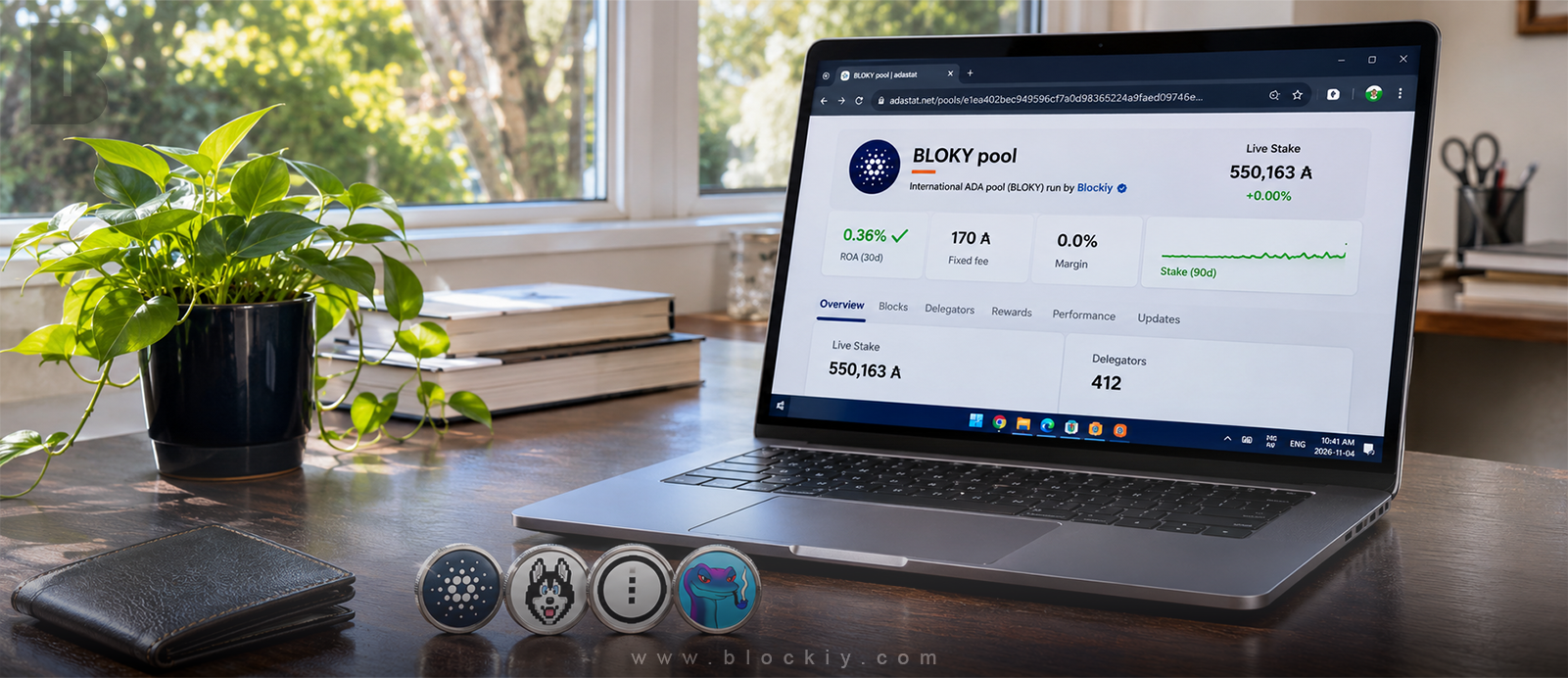
Blockiy’s BLOKY pool has an additional airdrop program for qualifying ADA delegators. The program lists NIGHT, SNEK, and HOSKY as three token rewards alongside ordinary ADA staking rewards. This is an incentive administered by Blockiy, not a second reward automatically paid by Cardano’s staking protocol.
To participate in the published program, you delegate to BLOKY, meet the first eligible balance tier of 1,000 ADA, create and verify a Blockiy account, and register the public Cardano stake address associated with your delegation. Blockiy checks the actual on-chain delegation and eligible balance. Simply moving your ADA delegation to BLOKY without completing the account and address steps does not complete the published enrollment process.
The rewards follow balance bands, not a straight line that pays exactly twice as many tokens for twice as much ADA. Here are a few examples from the currently published tiers:
| Eligible ADA delegated to BLOKY |  NIGHT |  SNEK |  HOSKY |
|---|---|---|---|
| 1,000–9,999 | 10 | 1,000 | 10,000,000 |
| 10,000–24,999 | 20 | 2,000 | 20,000,000 |
| 25,000–49,999 | 30 | 3,000 | 30,000,000 |
| 100,000–199,999 | 50 | 5,000 | 50,000,000 |
| 1,000,000 or more | 100 | 10,000 | 100,000,000 |
These are token quantities per eligible epoch under the displayed rates, subject to eligibility checks and distribution. They are not dollar values. Someone with 10,000 ADA and someone with 20,000 ADA sit in the same displayed band, even though their ordinary ADA staking rewards would generally reflect different stake amounts. The intermediate bands have their own quantities; use the current program details when you make a decision.
Put your amount into the calculator
Before deciding whether a tier makes sense for your wallet, try the Blockiy Airdrop Calculator | NIGHT, SNEK & HOSKY. Enter the ADA you would actually delegate to BLOKY. The calculator shows estimated quantities for the three tokens per five-day epoch, as a monthly average, and across a year. You do not need to connect your wallet to test different amounts.
For example, 15,000 eligible ADA falls in the 10,000–24,999 band, which currently displays 20 NIGHT, 2,000 SNEK and 20 million HOSKY per eligible epoch. If you instead enter 24,000 ADA, the three token quantities stay in that band. Enter 25,000 ADA and the displayed tier changes. That makes the calculator particularly useful for understanding thresholds; it does not tell you the market value of the tokens.
The monthly and yearly figures assume that the eligible balance stays in the same band and the current program rates continue. Blockiy’s yearly projection uses 73 epochs, and the monthly projection is an average derived from that yearly number. Neither projection confirms your wallet’s eligibility or proves that tokens have already been sent. For that, use your registered account status and payment history.
Will switching pools interrupt your ADA rewards?
This is often the question that stops an existing staker from changing pools. Cardano’s staking process uses snapshots and a delayed reward pipeline. If you redelegate in epoch N, the new choice is captured at the next relevant snapshot, your stake becomes active with the new pool in N+2, and rewards attributable to that participation are paid later, around N+4. Your old pool can still account for rewards that were already in the pipeline. Under the normal cycle, its rewards continue through the transition and the new pool takes over in subsequent payouts, so a routine redelegation does not impose a new-staker-style gap in ADA rewards.
That does not mean your old and new pools both pay you ADA for the same stake in the same earning epoch. A wallet may show rewards arriving from the old pool after you have already selected the new one because those rewards were earned earlier. Look at the earning epoch, not just the day a reward appears.
Also distinguish ADA reward timing from Blockiy’s airdrop timing. The protocol’s snapshot pipeline determines ordinary staking rewards; Blockiy’s separate program checks your delegation and balance under its own rules and processes token distributions on its schedule. An ADA reward appearing after you switch is not evidence that a token airdrop should arrive on that same date.
| Event | What happens |
|---|---|
| You select BLOKY in your wallet | A delegation transaction records your new pool choice; your ADA remains in the wallet |
| Cardano’s snapshots progress | Your stake becomes active for the new pool after the protocol’s delay |
| Pending ADA rewards arrive | Rewards earned through the previous pool can still arrive after the switch |
| You register with Blockiy | The separate airdrop program can check your public stake address and eligibility |
| Tokens are distributed | Any qualifying allocation follows Blockiy’s checks and distribution schedule |
A practical switch checklist
If you decide BLOKY fits your goals after comparing it with your current pool, use a deliberate sequence rather than following a message that promises instant tokens.
1. Check your current pool. Record its ticker or pool ID, fees, saturation, recent and longer-term block production, and your past ADA rewards. This gives you a baseline for comparison.
2. Check the destination pool’s identity. Search for BLOKY inside a trusted Cardano wallet and verify its pool details against Blockiy’s published pool information. A ticker is a short label; checking the full pool identity helps prevent a lookalike mistake.
3. Redelegate from your own wallet. Sign the delegation transaction there. You do not transfer your ADA to a person, a pool operator or a website to change pools. Keep enough ADA for the network transaction fee.
4. Find the correct public stake address. A mainnet stake address begins with stake1. It identifies the staking credential Blockiy uses to inspect delegation. A payment address commonly starts with addr1; a recovery phrase or private key should never be entered into an airdrop registration form.
5. Register and verify your Blockiy account. Save that matching public stake address and follow the account’s delegation confirmation flow. If you manage several wallets or staking accounts, make sure you register the one actually delegated to BLOKY and holding the eligible balance.
6. Monitor the two reward histories separately. Your Cardano wallet shows ADA staking rewards. Your Blockiy account tracks airdrop eligibility, status and payments. Give the network snapshot cycle and the program’s checks time to run before judging a missing payment.
Is the extra airdrop worth switching for?
There is no honest answer based on token counts alone. A million units of one asset can be worth less than one unit of another. NIGHT, SNEK and HOSKY have separate market prices, liquidity and risks. The amount you might actually realize from selling a token can differ from a price displayed on a tracker, especially if liquidity is thin or prices move.
Consider an illustrative comparison: suppose your current pool produces an average annualized ADA return of 2.0%, while another pool’s future return turns out to be 1.8%. On 20,000 ADA, that hypothetical difference is 40 ADA over a year before any other changes. It is not a claim about either real pool’s current rate. The right question is whether the extra token program’s possible, uncertain value and your preference for that pool justify any difference in ADA rewards and the effort of switching. If the new pool performs better instead, the arithmetic changes in the other direction.
Make the comparison in two columns, keeping units separate:
| Your current pool | A possible new pool |
|---|---|
| Expected ADA rewards, using a realistic range | Expected ADA rewards, using a realistic range |
| Current fees, performance and saturation | New fees, performance and saturation |
| Any existing incentives you would give up | Any new program and its eligibility conditions |
| Your reason for supporting that operator | Your reason for supporting the new operator |
Do not add projected NIGHT, SNEK and HOSKY units to an ADA return percentage. If you choose to value the tokens in ADA or dollars, show your price assumption and recognize that it can change. Equally, do not buy extra ADA solely to cross an airdrop tier without first considering the cost and price risk of acquiring it.
Five ways people misread staking airdrops
“I already stake ADA, so I am automatically enrolled.” Cardano staking and Blockiy’s registration are separate. A wallet delegated elsewhere does not qualify for the BLOKY-specific program, and a BLOKY delegator still needs to complete the published account steps.
“The calculator says yearly, so those tokens are mine.” A yearly figure assumes continued eligibility, unchanged tiers and a full projected period. It is useful for comparing scenarios, not for checking what has been paid.
“I switched today, so this week’s ADA reward must be from BLOKY.” Rewards already in Cardano’s pipeline can still come from the previous pool. Check the earning epoch.
“The highest token count must be the best deal.” Token quantity says nothing by itself about liquidity, market value or the pool’s ADA reward performance.
“I need to send my ADA to claim the promotion.” Delegation is a signed wallet transaction, not a transfer of your principal to an operator. Do not disclose recovery words or approve an unexplained transaction because someone advertises an airdrop.
When staying with your current pool may make more sense
A well-run current pool may already match your priorities. It may have transparent operations, competitive fees and a community you want to support. You may prefer predictable ADA-only accounting to an additional token incentive whose future value is uncertain. If your wallet holds less than Blockiy’s 1,000 ADA first tier, the airdrop is not an immediate reason to switch under the currently published rules.
You also do not need to move every ADA holding to one pool if your wallet setup supports separate stake accounts. But separate stake credentials may be assessed separately by a program that verifies an individual stake address. Do not assume balances across unrelated wallets are automatically combined for an airdrop tier.
The purpose of reviewing your delegation is to make an informed choice, not to chase every promotion. A program’s token rates can change; the ADA you control, the pool you support and the risks you accept should still make sense without a projected airdrop.
Frequently asked questions
Can I switch pools without unstaking or losing my ADA?
Yes. In ordinary Cardano delegation, you select a new pool from your wallet and sign a delegation transaction. Your ADA remains under your control and spendable. Pending rewards from the old pool continue through Cardano’s normal transition cycle.
Does Blockiy replace my ADA staking rewards with tokens?
The published BLOKY program presents NIGHT, SNEK and HOSKY as an additional incentive alongside ordinary ADA staking rewards. The ADA rewards are determined by Cardano’s protocol; the token distributions are handled separately by Blockiy under its program conditions.
Will a smaller pool always pay less ADA?
No. A smaller pool tends to earn rewards less frequently and less evenly from epoch to epoch. A brief comparison may mislead. Assess performance and fees over a suitable period, and understand that neither a small nor a large pool guarantees a future return.
Do I need a new wallet to delegate to BLOKY?
Usually not if you already use a self-custody Cardano wallet that supports delegation. Change the pool selection for the relevant stake account. Keep track of that account’s public stake1 address for the Blockiy registration step.
When will the extra tokens arrive after I switch?
The calculator cannot determine a payment date. First, complete the account and stake-address steps and wait for the on-chain delegation and eligible balance to be confirmed. Any token transfer then follows the program’s distribution schedule. Check your account status and payment history rather than assuming the ADA reward date is the airdrop date.
Can I receive the airdrop with 999 ADA?
Not under the currently published first tier, which begins at 1,000 eligible ADA. That threshold belongs to Blockiy’s token program; Cardano’s regular staking does not require a 1,000 ADA balance.
Make the pool choice an active decision
If you are already staking ADA, you have done the hard first step: you have a wallet and a working delegation. Now take a few minutes to review what your current pool delivers. Compare its performance, fees, saturation and operator communication with any pool you are considering.
If BLOKY suits those priorities, its separate NIGHT, SNEK and HOSKY program may add a reason to choose it. Work from your actual eligible balance, understand the tiers, register the correct public stake address and track the token program independently from your ADA rewards. Your pool choice can unlock more than ADA, but the best choice is the one whose full set of trade-offs you understand.