
Monitor your Cardano stake pool from one clear workspace
Blockiy Pool Intelligence is a monitoring and public reporting service built for Cardano stake pool owners. Add your ticker and Pool ID to review the pool's current on-chain position, keep important operating details in one place, follow recent epoch activity and publish a verified page that explains your pool clearly to delegators.
Built around the daily needs of a stake pool operator
Running a Cardano stake pool means watching two different sides of the operation. The blockchain shows registration, stake, delegators, fees and block history. The operator also has to remember details the blockchain cannot see, such as KES expiry, node version, relay information, P2P status and recent maintenance. When these details live in separate explorers, server notes and spreadsheets, it becomes harder to understand the pool quickly and harder to explain it professionally to other people.
Blockiy brings those pieces into one monitoring flow. The private dashboard gives the owner a practical place to analyze and maintain the pool's information. The verified public page then presents the appropriate data in a consistent format, so the operator can share a useful and transparent profile instead of sending delegators through several unrelated websites.
Blockiy Score and pool status at a glance
The first part of the public monitor gives the operator a compact summary of the pool's verified identity and current status.
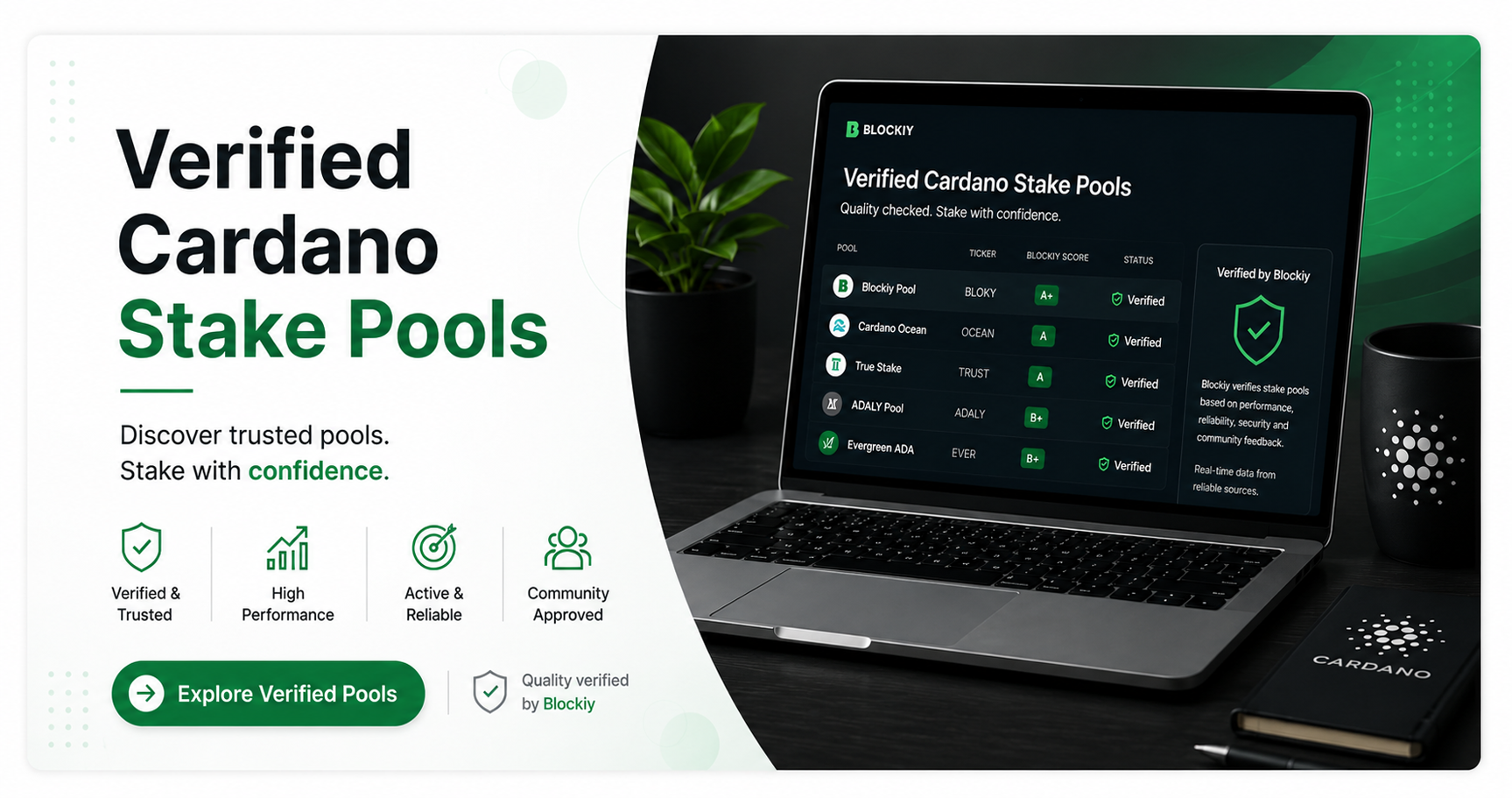
The page begins with the pool name, ticker and a short public description, followed by separate indicators for Blockiy approval and on-chain registration. This makes an important distinction: Blockiy approval confirms that the submitted pool information has been reviewed inside the platform, while the on-chain status reflects the registration information available from Cardano.
The Blockiy Score appears in the same overview as a trust and readiness indicator. It is designed to summarize the quality and completeness of the pool's verified information and operational profile. It is not a promise of future rewards, a prediction of block production or a replacement for a delegator's own research. For the pool owner, it is a clear way to show that the profile has been reviewed and kept up to date.

Pool Info and General Info
These sections organize the pool's identity, registration, network presence and economic settings into a readable operational snapshot.
Pool Info
The Pool Info section shows the on-chain ticker, registration date, registered relay count, lifetime blocks and registration status. It also presents the Pool ID in both Bech32 and hexadecimal formats. Keeping the identifiers together is useful when the operator needs to verify a registration, compare data between tools or share the correct pool identity with a service provider.
General Info
The General Info section explains the pool's current economic configuration and active network snapshot. Margin, fixed cost and declared pledge are shown beside active stake and active delegators. These values answer different questions, but they belong together: the fee settings describe how the pool is configured, while stake and delegator figures show its currently active scale.
Live Data for current delegation movement
The live section helps the operator notice changes that may not yet be reflected in the active stake snapshot.
Cardano's live and active values describe different points in the delegation cycle. The Live Data section therefore shows the current epoch, live stake, live delegators, the difference between live and active stake, blocks in the current epoch and the active epoch. Viewing these values together makes it easier to see whether stake is arriving, leaving or remaining stable before the next active snapshot takes effect.
This is especially useful for smaller pools, where one delegation change can represent a meaningful percentage of total stake. Instead of relying on a single total, the operator can compare live and active figures and understand whether the pool's current position is changing.
View detailed monitoring
Operator Monitoring Details
This section records the operating information that Cardano's public ledger cannot determine on its own.
The operator can add the KES key expiry date, current operating status, Cardano node version, registered relay count, primary relay address, server region, P2P networking status and last maintenance date. Together, these fields create a simple operational record that can be reviewed from the dashboard and, when appropriate, presented on the verified pool page.
KES expiry is one of the most important dates for an SPO to track because an expired operational certificate prevents normal block production until the keys are renewed correctly. Node version, P2P status and relay information provide a quick view of how the pool is being maintained, while the last maintenance date helps the owner keep routine operational work visible.
These fields are supplied by the operator and remain optional. When a value has not been entered, the public page displays it as N/A rather than guessing. Blockiy does not request signing keys, cold keys, wallet seed phrases, server passwords or other private credentials for this monitoring profile.
Current Epoch Pool Analysis
The current epoch analysis gathers the latest available pool metrics into one focused operating view.
This section shows the epoch number, delegator count, live stake, active stake, blocks produced during the epoch and lifetime blocks. The purpose is to let the owner review the current epoch without mentally combining values from several parts of an explorer.
For example, a rise in live stake may be visible before active stake changes. A new block can be read alongside the pool's delegator count and total stake rather than as an isolated event. The public page also states that the snapshot uses the latest cached Blockiy on-chain analysis, so visitors understand that the values are refreshed on a controlled schedule rather than claimed to be second-by-second telemetry.
View recent performance details
Recent Epoch Performance
A single epoch can be unusual, so the monitor places the current picture beside recent historical records.
The Recent Epoch Performance table presents up to ten available epoch snapshots. For each epoch, it can show active stake, delegators, blocks, return on stake, rewards and pool fee. This gives the owner a compact history for reviewing how the pool's stake and block activity have changed over time.
The table is descriptive rather than predictive. It shows what the available Cardano data reports for those epochs; it does not promise that a previous return, reward or block pattern will repeat. When a metric is not returned by the underlying data source, Blockiy displays “Not available” instead of filling the gap with an estimate.
View pool profile details
Pool Social & Contact Profiles
The monitoring page also becomes a verified communication point for the stake pool operator.
The owner can connect the pool website, public contact email, Telegram, Instagram, YouTube, X, Reddit, GitHub and Facebook. These are displayed as official links supplied by the operator, giving delegators and other SPOs a reliable place to find the correct communication channels.
This is more useful than scattering links across several directories. The pool's identity, monitoring information, current data and official profiles remain connected on one page. When someone wants to ask a question, review the operator's work or follow pool updates, they can begin from the verified profile instead of searching for accounts that may be outdated or unofficial.
Email alerts for important pool changes
The dashboard can notify the owner about selected events so routine monitoring does not depend on keeping the page open all day.
Operators can enable the currently supported notification types inside their account. Blockiy compares monitoring snapshots and sends an email when a supported change is detected. The goal is to highlight meaningful events rather than send a message after every refresh.
Receive a reminder when the saved KES expiry date is within ten days.
Receive an update when the pool's available lifetime block count increases.
Receive an alert when the available live delegator count changes from the previous snapshot.
The monitoring process uses caching, rate limits and controlled refresh intervals so the dashboard remains responsive while avoiding unnecessary requests to public Cardano data services.
Start Your Cardano Stake Pool Analysis
Create your Blockiy user account, add the ticker and Pool ID of the stake pool you operate, and run the first on-chain analysis. After the initial results are available, you can complete the optional operating details, select supported email alerts and submit the pool for review so its verified monitoring page can be published.