
Happy Birthday Cardano: 9 Years Since the Genesis Block
Nine years ago, Cardano’s genesis block marked the beginning of a new blockchain network.
On September 29, 2017, the Cardano mainnet entered its Byron era. At that point, Cardano did not yet have community-operated stake pools, decentralized governance, native assets, smart contracts, DeFi applications, or the broad ecosystem that exists today.
It was the beginning of a long-term experiment: can a blockchain become more scalable, more decentralized, more useful, and more community-governed without abandoning security and reliability?
Nine years later, Cardano is no longer only a technical promise. It is a live proof-of-stake network with ADA holders, delegators, stake pool operators, builders, wallets, exchanges, governance participants, and applications operating across the world.
That does not mean every goal has already been achieved. It has not.
Cardano still has important work ahead in adoption, liquidity, user experience, scalability, developer growth, and making its technology useful to people outside the existing community.
But a ninth anniversary is a good moment to look at the full picture: where Cardano began, what it has built, what has changed, and what needs to happen for the next nine years to matter even more than the first.
What the Genesis Block Actually Represents
A genesis block is the first block of a blockchain.
It establishes the starting state of the ledger: the initial rules, initial distribution, and foundation that every later block extends. Every ADA transaction, every staking reward, every native token, every governance action, and every smart-contract interaction on Cardano ultimately traces back to that starting point.
Cardano’s genesis launched the Byron era in 2017.
At the time, the network’s purpose was relatively focused. Users could hold and transfer ADA, use early wallets, and interact with the chain through basic infrastructure. The blockchain was operational, but it was not yet decentralized in the way Cardano users understand today.
The early network was maintained by its founding entities. That was an important first step, but not the end goal.
Cardano’s longer-term vision was always to transfer more responsibility to the community: people running stake pools, ADA holders delegating their stake, developers building applications, and governance participants shaping future upgrades.
That transition took years of development, testing, and gradual rollout.
From Byron to a Full Proof-of-Stake Network
The biggest change in Cardano’s early history came with Shelley.
Before Shelley, Cardano block production was managed by a federated group. Shelley introduced the foundation for community-led decentralization through stake pools and delegation.
This changed the role of ADA holders.
Instead of simply holding ADA, users could delegate their stake to a pool. Stake pool operators could run infrastructure, produce blocks, participate in the network, and earn rewards based on performance and delegation.
The basic model is still one of Cardano’s strongest features today:
- ADA remains in the holder’s wallet.
- Delegation does not transfer ownership of ADA to the pool.
- Delegators can change pools when they choose.
- Stake pools compete on reliability, fees, communication, and infrastructure quality.
- The network becomes more resilient when block production is spread across independent operators.
This was not only a technical milestone. It created an economic and social system around Cardano.
Thousands of people began operating or supporting stake pools. Delegators became more aware of decentralization, performance, fees, pledge, community contributions, and the importance of distributing stake instead of concentrating it in a small number of operators.
Why Cardano Staking Still Matters Nine Years Later
Staking is sometimes described only as a way to earn ADA rewards. That explanation is incomplete.
The larger purpose of staking is network participation.
When ADA holders delegate to independently operated pools, they help distribute block production and reduce reliance on a small number of entities. A healthy staking ecosystem is therefore part of Cardano’s security model, not simply a passive yield product.
For delegators, the practical question is not only “Which pool advertises the highest reward?”
A better question is:
“Which pool is reliable, transparent, professionally operated, and contributing to a more decentralized Cardano?”
Pool selection should consider several factors:
- Uptime and block-production reliability.
- Margin and fixed-fee structure.
- Pool saturation and active stake.
- Operator communication and transparency.
- Infrastructure quality and monitoring.
- Long-term commitment to Cardano.
- Whether the pool is independently operated.
- Community contribution, tools, education, or open-source work.
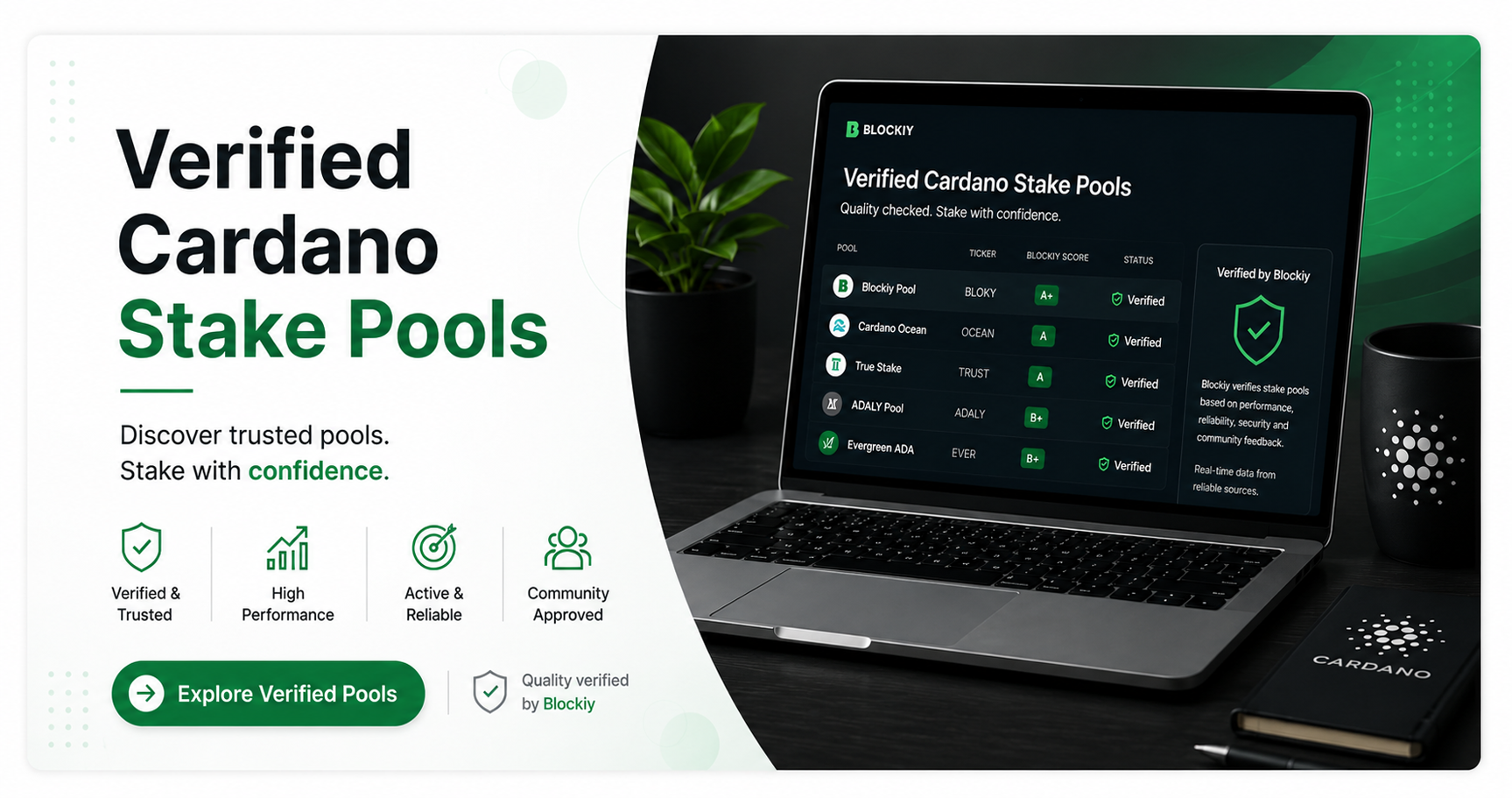
If you want a practical place to begin comparing established operators, Blockiy’s Cardano Verified Pools directory helps ADA holders discover verified stake pools and evaluate more than just a ticker or a headline reward percentage.
A good delegation decision supports both your own staking strategy and the health of the network.
Native Assets Changed What Cardano Could Be
Cardano’s early years focused on building the foundation. The next major stage was expanding what could exist on the chain.
The introduction of native assets made it possible to create and transfer tokens directly on Cardano without requiring every asset to be represented through a smart contract.
That opened the door to:
- Community tokens.
- Stablecoins.
- NFT collections.
- Tokenized assets.
- Governance tokens.
- Gaming assets.
- Loyalty programs.
- Payment tokens.
- Decentralized-finance assets.
Native assets made Cardano more than a network for ADA transfers.
They gave builders a way to create digital assets that could be handled directly by wallets, exchanges, marketplaces, and applications. This became an important part of the ecosystem’s later growth.
However, issuing tokens is not the same as building useful products.
The real value of native assets depends on whether they are connected to active applications, real communities, meaningful liquidity, and clear use cases. The next stage of Cardano’s development must continue moving from token creation toward durable economic activity.
Smart Contracts Moved Cardano Into a New Era
Smart contracts were another major turning point.
They made it possible for Cardano to support decentralized applications that follow rules written into code rather than relying entirely on a centralized company or intermediary.
That created new possibilities for:
- Decentralized exchanges.
- Lending and borrowing.
- NFT marketplaces.
- Stablecoin systems.
- Governance applications.
- On-chain games.
- Token launches.
- Identity tools.
- Treasury systems.
- Financial products.
Smart contracts also changed the expectations around Cardano.
Once a network supports applications, the market begins asking harder questions:
- Are users actually using the applications?
- Is liquidity deep enough?
- Are transactions simple enough for ordinary people?
- Can developers build efficiently?
- Are wallets easy to use?
- Can applications compete with alternatives on other networks?
These are fair questions.
A smart-contract platform should not be judged only by whether the technology exists. It should be judged by whether builders can turn the technology into products people genuinely want to use.
The Vasil Upgrade Showed Why Infrastructure Matters
Cardano’s later upgrades focused not only on adding features but also on improving performance and developer experience.
The Vasil upgrade strengthened Cardano’s smart-contract infrastructure through improvements such as reference scripts, inline datums, and reference inputs.
For ordinary users, these changes were not always visible.
But behind the scenes, they helped applications become more efficient and reduced unnecessary transaction complexity in certain use cases. This matters because blockchain infrastructure needs to be useful not only for early adopters but also for products that may eventually serve a much larger audience.
The lesson is important.
Not every major Cardano improvement produces an immediate headline or instant market reaction. Some of the most valuable changes are the ones that quietly give builders better tools, reduce friction, and make future applications more practical.
Cardano Became More Than a Network: It Became a Community-Governed System
One of Cardano’s most ambitious goals has been self-governance.
A decentralized blockchain should not depend forever on a single company deciding how the protocol evolves. But moving from centralized coordination to community governance is difficult.
It requires clear rules, technical understanding, participation, accountability, and a process for funding useful work without losing focus.
Cardano’s governance era has begun to give the community a more formal role in:
- Protocol upgrades.
- Treasury decisions.
- Funding proposals.
- Governance representation.
- Network direction.
- Long-term ecosystem priorities.
This is one of the most important changes in Cardano’s first nine years.
The question is no longer only whether Cardano can technically evolve. The question is whether its community can make good decisions at scale.
Strong governance could become a major advantage. It can help Cardano fund infrastructure, support builders, improve tools, and respond to new opportunities without depending on a small group.
Weak governance could create delays, confusion, short-term spending, or endless disagreement.
The next few years will show whether Cardano’s governance system can become one of the network’s greatest strengths.
What Cardano Has Achieved in Nine Years
After nine years, Cardano has built a foundation that many newer projects have not had time to develop.
Its important achievements include:
- A continuously operating proof-of-stake blockchain.
- A large global staking ecosystem.
- Independent stake pool operators producing blocks.
- Delegation without locking or giving custody of ADA to a pool.
- Native assets and multi-asset functionality.
- Smart-contract capabilities.
- A growing DeFi and application ecosystem.
- Multiple wallet options.
- Decentralized governance infrastructure.
- A strong focus on formal methods, research, and careful protocol design.
- A global community of holders, developers, operators, educators, and builders.
These achievements should not be dismissed simply because they were built gradually.
At the same time, anniversaries should not become an excuse for ignoring the work still ahead.
The market does not reward a blockchain forever for what it achieved years ago. It rewards networks that continue to improve, attract users, solve real problems, and remain relevant as technology and user expectations change.
The Challenges Cardano Still Needs to Solve
Cardano has a strong base, but it is entering a more competitive period.
Many networks are competing for developers, stablecoin liquidity, institutional access, consumer applications, and attention. Cardano must continue proving not only that it is technically capable, but that it is one of the best places to build and use useful products.
The most important challenges include:
Deeper DeFi Liquidity
A decentralized-finance ecosystem needs deep and reliable liquidity.
Without it, users face poor swap pricing, high price impact, limited borrowing capacity, and fewer reasons to stay on the network. Strong liquidity is necessary for stablecoins, lending, trading, payments, and more advanced financial products.
Temporary incentives can bring capital quickly. Durable liquidity is harder and more valuable.
The goal should be markets that remain useful because people genuinely need them, not only because a short-term reward campaign is active.
Better Stablecoin Use
Stablecoins can make blockchain applications more practical for everyday users.
People may be interested in receiving payments, saving, trading, borrowing, or sending money without being exposed to the price movement of ADA during every transaction.
A stronger stablecoin economy could support:
- Payments.
- Lending.
- Cross-border transfers.
- Treasury management.
- Merchant tools.
- Decentralized trading.
- Tokenized assets.
- Business use cases.
Stablecoins can also help onboard people who are not initially interested in buying ADA as an investment but may still benefit from using Cardano applications.
Simpler User Experience
A blockchain can have excellent technology and still lose users if the first experience is too complicated.
Cardano needs wallets and applications that make basic actions simple:
- Creating a wallet securely.
- Receiving ADA.
- Delegating stake.
- Understanding transaction fees.
- Using decentralized applications.
- Swapping assets safely.
- Tracking transactions.
- Recovering from common mistakes.
Users should not need to become blockchain experts to complete a simple financial action.
The technology underneath can be complex. The experience should feel clear.
More Visible Applications With Real Users
Cardano does not need thousands of projects that nobody uses.
It needs more applications with clear traction: products that solve a real problem, retain users, generate meaningful activity, and show why Cardano is the right network for that use case.
That could include:
- A widely used payment product.
- A stablecoin platform with real transaction volume.
- A lending protocol with durable liquidity.
- A Bitcoin-related financial application.
- A tokenized real-world asset platform.
- A consumer marketplace.
- A gaming or social application.
- A business or enterprise use case with visible adoption.
A few strong success stories can change outside perception more than hundreds of unfinished announcements.
Faster Growth Without Sacrificing Decentralization
Cardano’s future roadmap includes important work around scalability, settlement, transaction handling, and developer capabilities.
The challenge is to improve performance while preserving the characteristics that make Cardano valuable: decentralization, predictable operation, security, and resilience.
This balance matters.
A network can increase capacity by making it harder for smaller operators to participate. That may improve short-term numbers while reducing decentralization.
Cardano’s opportunity is to grow responsibly: support more users and more activity without turning into infrastructure that only a small group can operate.
What ADA Holders Should Learn From This Anniversary
For ADA holders, nine years of Cardano should be a reminder to focus on long-term evidence rather than short-term noise.
Price matters to investors, but price alone does not explain whether the network is becoming stronger.
Useful things to watch include:
- Growth in active users.
- Stablecoin supply and usage.
- DeFi liquidity that remains after incentives decline.
- Transaction volume linked to real applications.
- Wallet and onboarding improvements.
- New developers and products entering the ecosystem.
- Stake distribution and pool diversity.
- Governance participation and decision quality.
- Scaling progress.
- Real businesses using Cardano infrastructure.
No single metric tells the entire story.
But when several of these improve together, Cardano becomes more credible as a growing economic network rather than simply an asset people hold and discuss.
What Stake Pool Operators Can Contribute to the Next Nine Years
Stake pool operators are not only block producers.
The strongest operators can help make the ecosystem more reliable, transparent, and accessible. They can contribute through:
- Stable and well-monitored infrastructure.
- Clear communication with delegators.
- Educational content.
- Open-source tools.
- Community support.
- Governance participation.
- Technical support for builders.
- Reliable relays and network connectivity.
- Honest reporting about pool performance.
- Long-term commitment during both bull and bear markets.
As Cardano becomes more active, infrastructure quality matters more.
A growing network needs operators who treat pool operation as a serious responsibility, not simply a passive income opportunity. The next nine years will reward the operators who combine technical reliability with real community value.
What Would Make Cardano’s Tenth Anniversary More Important?
By its tenth anniversary, Cardano does not need to solve every challenge in crypto.
But meaningful progress would be visible if the network has:
- More active users outside the existing ADA-holder base.
- Stronger stablecoin and DeFi liquidity.
- Easier onboarding for new users.
- More widely used applications.
- Clear scalability progress.
- Better developer tools.
- Stronger governance participation.
- More businesses and institutions using Cardano infrastructure.
- A healthy and diverse stake pool ecosystem.
- A clearer connection between technical progress and real adoption.
That is the standard that matters.
Not a single announcement. Not a temporary price rally. Not a marketing campaign.
Real users, real products, real liquidity, and real economic activity.
The Bottom Line
Cardano’s ninth birthday is more than a celebration of a genesis block.
It is a reminder that building a global decentralized network takes time.
Over nine years, Cardano has moved from a foundational proof-of-stake blockchain into an ecosystem with staking, native assets, smart contracts, decentralized governance, applications, and a worldwide community of participants.
The network has achieved a great deal. It has also entered the stage where execution matters even more.
The next chapter will be defined by whether Cardano can translate its infrastructure, community, governance, and technical design into products that are simple, useful, liquid, and widely adopted.
If it succeeds, the next nine years could matter far more than the first nine.
Happy birthday, Cardano.