Stake ADA, Unlock Three More Tokens: How Blockiy’s Airdrop Works
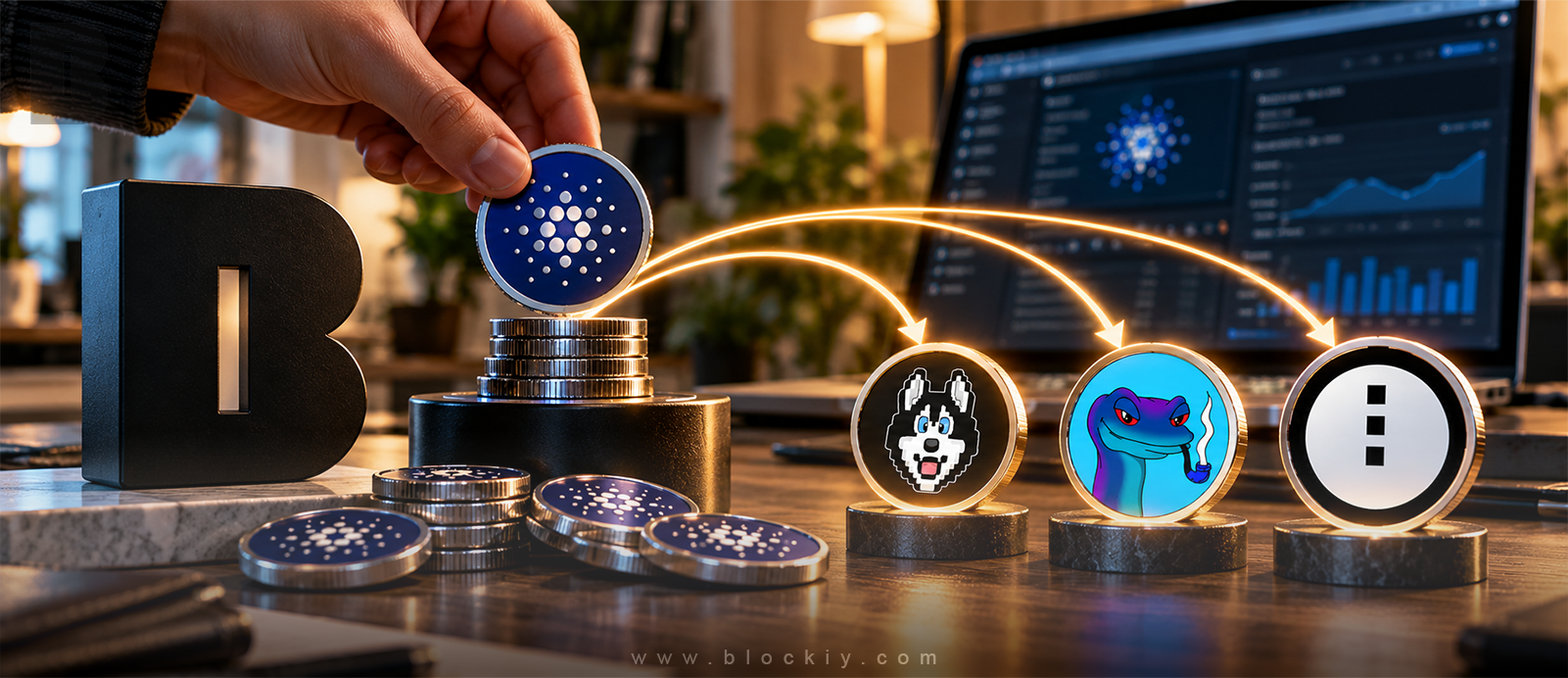
Delegating ADA usually means one kind of reward: more ADA. Blockiy adds a separate incentive for people who delegate to its BLOKY stake pool. Eligible participants can receive three Cardano tokens—NIGHT, SNEK, and HOSKY—alongside their regular staking rewards.
That sounds simple until you ask the practical questions. Do you have to send ADA anywhere? How much do you need? Is 10,000 ADA ten times more rewarding than 1,000? And when a calculator says “per epoch,” does that mean three tokens will land in your wallet every five days?
Here is how the program works, what its current reward tiers actually show, and how to check your participation without confusing an estimate with a payment.
First, understand the two separate reward systems
When you delegate to BLOKY, Cardano’s staking protocol handles your ADA staking rewards. Your wallet continues to control your ADA, and your stake supports the pool. If the pool earns rewards, the network calculates your share according to Cardano’s staking rules. Those rewards are paid in ADA.
Blockiy’s token airdrop is a separate program operated by Blockiy. It checks whether your public stake address is delegated to BLOKY and whether your eligible ADA balance meets a reward tier. The program then handles NIGHT, SNEK, and HOSKY allocations according to its eligibility checks and distribution schedule.
| Question | Cardano staking rewards | Blockiy airdrop |
|---|---|---|
| What do you receive? | ADA | NIGHT, SNEK, and HOSKY |
| Who administers it? | Cardano’s staking protocol | Blockiy’s program |
| What is required? | A delegated Cardano stake address | BLOKY delegation, at least 1,000 eligible ADA, a Blockiy account, and a registered public stake address |
| Where do you track it? | Your wallet or a Cardano explorer | Your Blockiy account dashboard and payment history |
| Is the amount guaranteed? | No; pool performance and network rules affect ADA rewards | No; projected quantities depend on your qualifying balance, checks, current tiers, and distribution |
The distinction matters when you troubleshoot. Seeing an ADA reward in your wallet does not by itself mean you have completed Blockiy’s account registration. Equally, a token estimate in the calculator is not an ADA staking reward.
What are the three extra tokens?
The program lists NIGHT, SNEK, and HOSKY as three separate assets. They have different quantities in every tier: a reward of 20 NIGHT, 2,000 SNEK, and 20 million HOSKY means three different token balances. It does not mean those balances have equal market value. Token supply, liquidity, and price differ, and any token’s market value can change sharply.
It helps to read the offer as “three additional token quantities if eligible,” not as a fixed extra percentage return. These tokens are also distinct from ADA, which you may earn through ordinary staking. Neither the number of HOSKY units nor the number of SNEK units tells you what an airdrop would be worth in dollars.
Who qualifies for Blockiy’s airdrop?
The published process has four parts:
- Delegate your ADA to the Blockiy pool with ticker BLOKY.
- Hold at least 1,000 eligible ADA for the first reward tier.
- Create a Blockiy account and verify your email.
- Register your wallet’s public stake address in the account and confirm your delegation.
Blockiy checks the on-chain delegation and the qualifying balance. Delegating ADA alone does not complete the account step. Registering an address alone does not create an eligible delegation. And an amount you intend to buy or transfer later does not count as the balance confirmed during an eligibility check.
One important detail: Cardano itself has no 1,000 ADA minimum for ordinary delegation. The 1,000 ADA threshold belongs to this specific token program. Someone staking 500 ADA can still participate in Cardano staking, but that balance is below Blockiy’s published first airdrop tier.
How much NIGHT, SNEK, and HOSKY could you receive?
Blockiy currently publishes fixed balance bands. The numbers below are token quantities per eligible epoch, subject to the program’s checks and distribution schedule.
| Eligible ADA delegated to BLOKY |  NIGHT |  SNEK |  HOSKY |
|---|---|---|---|
| 1,000–9,999 | 10 | 1,000 | 10,000,000 |
| 10,000–24,999 | 20 | 2,000 | 20,000,000 |
| 25,000–49,999 | 30 | 3,000 | 30,000,000 |
| 50,000–99,999 | 40 | 4,000 | 40,000,000 |
| 100,000–199,999 | 50 | 5,000 | 50,000,000 |
| 200,000–299,999 | 60 | 6,000 | 60,000,000 |
| 300,000–399,999 | 70 | 7,000 | 70,000,000 |
| 400,000–499,999 | 80 | 8,000 | 80,000,000 |
| 500,000–999,999 | 90 | 9,000 | 90,000,000 |
| 1,000,000 or more | 100 | 10,000 | 100,000,000 |
Notice what the table does not do: it does not multiply rewards continuously by your ADA balance. A wallet with 1,100 ADA and one with 9,500 ADA sit in the same first band. A wallet with 9,999 ADA remains in that band; reaching 10,000 ADA moves it to the next one, provided that balance is confirmed as eligible. Adding ADA within an existing band does not change the published token quantity for that band.
For a concrete example, 15,000 eligible ADA falls in the 10,000–24,999 band: 20 NIGHT, 2,000 SNEK, and 20,000,000 HOSKY per eligible epoch under the current table. That is a statement about possible token units, not a promise of payment at a particular time or a calculation of their cash value.
Use the calculator before making assumptions
If you are comparing balances or wondering how much the next tier changes the result, enter your planned or current BLOKY delegation in the Blockiy staking airdrop calculator. It displays estimated NIGHT, SNEK, and HOSKY quantities per Cardano epoch, as an average per month, and over a year. The calculator does not need to connect to your wallet.
Its longer-term numbers assume that your eligible balance remains in the same tier and that the current reward rates continue. The monthly estimate takes the per-epoch quantity, multiplies it by 73 epochs per year, and divides by 12; it does not mean a calendar month always contains the same number of eligibility checks or payments. The yearly figure is the per-epoch estimate multiplied by 73. Neither figure predicts token prices, confirms your registration, or guarantees 73 paid epochs.
For example, if your balance qualifies for 20 NIGHT per epoch, the simple annual projection is 1,460 NIGHT. That is useful for comparing tiers. It is not a claim that 1,460 NIGHT has already been earned, that the program terms will never change, or that a year’s tokens will arrive in a single transaction.
How to join, step by step
1. Start with a wallet you control
Use a Cardano wallet that lets you delegate ADA and view your stake address. Make sure you can access the wallet securely and that you understand which staking account you are using. If you keep ADA on an exchange, the exchange may control the delegation and the stake address; having an ADA balance there is not the same as registering a self-controlled stake address for this program.
Your ADA does not need to be sent to Blockiy. Delegation is an on-chain choice about which pool your stake supports; the ADA remains spendable in your wallet. A normal delegation transaction may require a network fee, and first-time stake-key registration may involve Cardano’s refundable stake deposit. Neither is a payment for three airdrop tokens.
2. Choose the correct pool
In your wallet’s staking section, search for BLOKY and inspect the pool details before confirming. Pool tickers are convenient labels, so check the pool identity shown by your wallet if there are similar names. Confirm the delegation transaction in your own wallet and allow the network time to reflect the new status.
You do not need to “lock” your ADA for this step. You can still move it, but moving enough ADA to cross a tier boundary may change a future qualifying balance. Redelegating to another pool can also affect future airdrop eligibility. Cardano’s normal staking reward cycle and Blockiy’s program checks have their own timing; do not assume that changing pools produces or cancels both kinds of rewards on the same day.
3. Create and verify your Blockiy account
Sign up with Blockiy, verify your email, and go to the Staking ADA and Get Airdrop section. If you already have an account, sign in instead of making a second account for the same stake address.
This is the part that connects the public on-chain delegation to your program dashboard. Simply holding ADA or looking at a projected reward does not register you.
4. Register your public stake address
Copy the stake address associated with the wallet you delegated. A Cardano mainnet stake address starts with stake1. Save it in your Blockiy account and use the dashboard’s confirmation step so the program can check your actual pool delegation and eligible balance.
A stake address is different from a payment address, which commonly starts with addr1. It is also different from a seed phrase or private key. Blockiy needs your public stake address for this check; it should never need the recovery words that control your wallet. If you use multiple wallets or multiple stake credentials, check which address actually holds the eligible delegation you intend to register.
5. Follow the status and payment history
Check the dashboard for delegation status, reward tier, reward status, and airdrop payment history. Registration starts verification; it does not make the tokens arrive immediately. Token distributions are processed according to Blockiy’s schedule. If a payment has been recorded, compare the amount and transaction details with what your wallet or a Cardano explorer shows before assuming an entry is missing or complete.
Why the timing can feel confusing
Cardano runs in epochs of approximately five days. A new delegation takes time to pass through the network’s stake snapshots before ordinary ADA staking rewards appear. The first ADA payout often takes roughly 15–20 days after a new delegation, with subsequent rewards following the epoch cycle when the pool earns them.
Blockiy’s airdrop calculator also uses a five-day epoch as its unit of projection, but that does not establish an instant on-chain token payment every five days. The airdrop depends on program verification and distribution. You could see an eligible tier before seeing a token transfer, or see ADA staking rewards on a different schedule from airdrop payments. To check a delay, look separately at the wallet’s ADA reward history, your Blockiy eligibility status, and your airdrop payment history.
Here is a simple way to think about the order: delegate → register your stake address → pass eligibility checks → see any qualifying allocation and distribution. The first two steps are actions you take; the remaining steps depend on the program’s checks and payment process.
Five situations worth checking before you expect a payout
You have fewer than 1,000 eligible ADA. The calculator’s first airdrop band starts at 1,000 ADA, even though Cardano staking itself accepts smaller amounts. If you are close to the cutoff, leave room for wallet transaction fees and any spending that could reduce your qualifying balance.
You delegated to a different pool. Similar names or an old wallet selection can be misleading. Verify that the stake address you registered is actually delegated to BLOKY, rather than relying on a screenshot or an intended transaction.
You registered the wrong address. A payment address, an address from another wallet, or an old stake address may not match the eligible stake credential. Recheck the stake1 address displayed by the wallet you used for delegation.
Your balance crossed a tier boundary. If 10,100 ADA becomes 9,900 ADA by the relevant eligibility check, the first band applies under the current table, rather than the second. Conversely, adding ADA does not necessarily make a higher allocation appear instantly; wait for the program to confirm the updated qualifying balance.
You are comparing a projection with an actual payment. An annual calculator result assumes continuous eligibility and unchanged rates. The dashboard’s recorded status and payment history address what has been checked or distributed. Look at the time period and token separately before treating a difference as an error.
What does participation cost, and what are the risks?
Delegating does not hand your ADA to the pool operator. Cardano’s ordinary delegation does not slash delegated ADA for a pool’s mistakes, and the ADA remains available for spending. Still, a pool can underperform, which can reduce or eliminate ADA rewards in a particular epoch. Crypto prices can also move against you regardless of the number of coins or tokens in your wallet.
The airdrop adds a different set of considerations. Blockiy must verify and distribute the tokens; published rates and schedule should be checked when you participate. NIGHT, SNEK, and HOSKY have separate markets and risks. A large numerical token allocation does not imply a large realizable value. Your wallet may need to support Cardano native assets to display them clearly, and receiving or later moving native tokens can involve Cardano’s ADA-in-output requirements and transaction fees.
The easiest security rule is also the most useful: never reveal your recovery phrase, never sign an unexplained transaction, and never send ADA to a person claiming you must “activate” your airdrop. The legitimate verification flow described here uses a public stake address and on-chain delegation check.
Frequently asked questions
Do I need to stake NIGHT, SNEK, or HOSKY to receive them?
No. The published eligibility mechanism is based on ADA delegated to BLOKY, your registered public stake address, and the confirmed qualifying balance. The three tokens are the possible extra assets, not the asset you delegate.
Does every ADA holder get the three tokens automatically?
No. Ordinary ADA ownership and ordinary Cardano delegation do not automatically enroll you in Blockiy’s program. The published steps include BLOKY delegation, the 1,000 ADA minimum tier, a verified Blockiy account, and stake-address registration and confirmation.
Is the airdrop paid instead of my ADA staking rewards?
No. Regular ADA rewards and the token airdrop are distinct. You can evaluate the pool’s ADA staking performance separately from the three-token incentive.
If I delegate 20,000 ADA, do I get twice as many tokens as someone with 10,000 ADA?
No. Both amounts are in the 10,000–24,999 ADA band in the current table, so they show the same per-eligible-epoch token quantities. The next published band begins at 25,000 ADA.
Do I have to keep my ADA locked for a year to see the calculator’s yearly figure?
Cardano delegation does not lock ADA. The yearly figure is a projection of 73 five-day epochs at the currently displayed tier and rates, assuming continued eligibility. If you move funds, switch pools, or the program changes, the projection can diverge from actual distributions.
Why do I see ADA rewards but no NIGHT, SNEK, or HOSKY yet?
Check whether you created and verified your Blockiy account, entered the correct stake1 address, confirmed BLOKY delegation, met the minimum eligible balance, and have a recorded airdrop payment. ADA staking rewards follow Cardano’s protocol cycle; Blockiy token payments follow the program’s checks and distribution schedule.
Can I use a calculator result as proof that I am eligible?
No. The calculator estimates quantities from an amount you enter and requires no wallet connection. Eligibility is determined by the on-chain delegation and balance checks associated with the public stake address registered in your account.
The practical takeaway
Blockiy’s offer is easiest to understand as one ADA delegation with two independent outcomes: possible Cardano staking rewards in ADA, and a separate chance to qualify for NIGHT, SNEK, and HOSKY airdrops. The published token amounts follow balance tiers, starting at 1,000 ADA. To participate, delegate to BLOKY, register and verify your Blockiy account, submit the matching public stake address, and monitor the dashboard for eligibility and payments.
Use the calculator to compare token quantities across tiers, then use actual account and on-chain records to see what has happened. That distinction turns an attractive headline into a decision you can check for yourself.