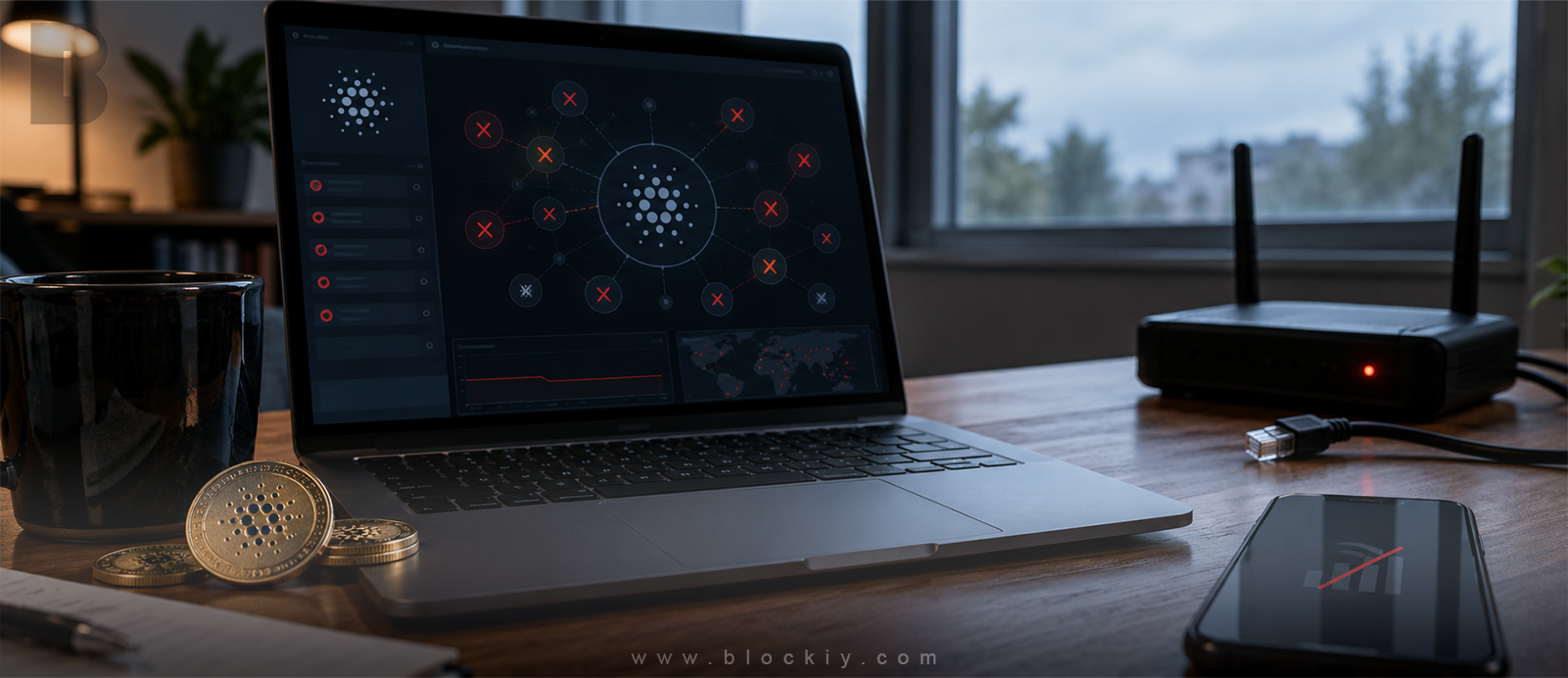
What Happens If the Cardano Network Goes Offline?
You open your Cardano wallet, try to send ADA, and nothing happens. The balance will not refresh. A transaction stays pending. An exchange announces that ADA withdrawals are temporarily unavailable.
Has Cardano stopped working? Is your money still there? Should you try sending it again?
If Cardano genuinely stops producing blocks, new transfers and other on-chain actions cannot settle until block production resumes. A temporary outage does not, by itself, erase your ADA, transfer ownership of it, or give a stake pool access to your funds.
The immediate problem is availability: you may still own your assets while being unable to move them. That distinction matters, especially if you need to make a payment, repay a loan, or withdraw collateral before a deadline.
But a wallet that appears offline is not enough to prove the blockchain has stopped. Before taking action, you need to identify which part of the system is actually failing.
What Does “Cardano Is Offline” Actually Mean?
Cardano consists of many independently operated nodes. Wallets, exchanges, explorers and applications connect to this network through their own infrastructure or third-party providers.
An interruption in any of those connections can look like a network outage from your screen.
| Situation | What it means | Likely effect on you |
|---|---|---|
| Your wallet cannot reach its backend | The wallet’s connection or data service is unavailable | Balances may look outdated; sending may fail |
| An exchange pauses ADA withdrawals | The exchange has suspended its own transfer service | You cannot withdraw through that exchange, even if Cardano is working |
| One stake pool goes offline | That pool’s infrastructure is unavailable | The pool may miss block opportunities; other pools can continue |
| An API or explorer falls behind | Its view of the chain is stale | Transactions or confirmations may appear missing |
| A wider network disruption occurs | Many nodes have trouble communicating or producing blocks | Transactions may take longer; different services may disagree temporarily |
| Block production stops across the network | The chain is not advancing | New on-chain transactions cannot settle |
A slow transaction can also result from congestion. If new blocks are still appearing, the chain is advancing, even if your transaction has not been included.
The useful first question is: Are blocks stopping, or has the service I am using stopped seeing them?
What Happens to the ADA Already in Your Wallet?
Your wallet does not hold ADA inside the application. It holds or manages the keys that authorize spending, while the blockchain records the outputs associated with your addresses.
If block production stops, those records do not disappear simply because no new blocks arrive. A phone losing its connection cannot delete your on-chain balance. Neither can a wallet backend going down.
Suppose you have 5,000 ADA in a self-custody wallet when an interruption begins. With no subsequent transaction changing that balance, the outage itself does not turn those 5,000 ADA into zero. You may be unable to spend them until service returns, but the interruption has not created a transfer to someone else.
There are three practical qualifications:
- Control still depends on your keys. Losing your recovery phrase or exposing it to a scammer is a separate problem that network recovery will not fix.
- Recent transactions need careful checking. A transaction near the chain tip has less settlement assurance than one with substantial block depth.
- Ownership does not guarantee a stable price. ADA’s market value can change while on-chain transfers are unavailable.
Native tokens and NFTs recorded on Cardano follow the same basic distinction between ownership and availability. Their on-chain records are separate from whether a marketplace, image host or wallet interface is accessible.
What Happens to Pending Transactions?
“Pending” can describe several different stages. A wallet might have created a transaction, submitted it to a server, or received an acknowledgment from a node. None of those steps alone proves that the transaction has entered a block.
A transaction that was never successfully submitted
If your wallet could not reach a submission service, the transaction may never have reached the network. Check its transaction ID and submission result before assuming the recipient has been paid.
A transaction ID identifies a transaction; it is not a receipt proving inclusion.
A transaction accepted by a node but not included
Nodes keep unconfirmed transactions in local mempools. A mempool is a temporary queue, not a permanent booking on the blockchain. Different nodes may have different queues, and a restart or revalidation can remove a transaction.
If the transaction remains valid, it may be included when conditions improve. But inclusion is not guaranteed just because your wallet previously displayed “submitted.”
A transaction whose validity window expires
Cardano transactions can have an upper validity bound. After that deadline, the transaction cannot be newly included under that validity window.
Imagine a payment built with a validity window ending at 14:30. If the chain remains unavailable beyond that point and the payment was never included, you may need to build and sign a replacement. Waiting longer does not extend the original transaction’s deadline.
Before replacing it, check whether it was included earlier and your wallet simply failed to update.
A transaction already included in a block
An included transaction is different from one waiting in a queue. Nevertheless, recent blocks can be affected by normal chain selection and rollbacks. A serious incident deserves additional caution around transactions close to the chain tip.
If no new blocks are produced, the transaction does not gain additional block depth just because you have waited another hour.
Avoid repeatedly creating fresh payments while the first payment’s status is uncertain. Re-submitting the identical signed transaction cannot create two copies of the same ledger transaction. Creating a separate transaction using different available inputs, however, can produce a second payment if both transactions eventually succeed.
Can an Outage Consume Your Transaction Fee or Collateral?
A normal ADA transfer that never enters the ledger does not incur an on-chain transaction fee merely because you clicked “send.” A wallet may temporarily reserve funds for a pending transaction, which can make the spendable balance look lower.
That reservation is not proof that ADA has been permanently deducted on-chain.
Smart-contract transactions require a separate distinction. Certain Plutus transactions use collateral for phase-2 validation failures. An outage, a submission timeout, or an expired validity interval is not automatically such a failure. However, an actual phase-2 failure recorded on-chain can trigger the collateral mechanism.
Check the ledger outcome rather than treating every wallet error as a fee charge—or assuming every unsuccessful contract interaction is free. Exchange and application service charges may also follow their own policies.
What Happens to Staked ADA and Rewards?
With native Cardano delegation, your ADA remains under your control. Delegation does not send your balance to the stake pool operator, and pool downtime does not give that operator permission to spend it.
Cardano’s native staking does not slash a delegator’s ADA because a pool misses blocks. A broader interruption does not introduce a special penalty that confiscates delegated principal.
Rewards are a different matter. If pools miss block-production opportunities, that can affect reward outcomes. During a complete halt, there are no new blocks carrying transactions, and no new transaction fees from those absent blocks.
The eventual reward effect depends on the interruption’s duration, when it occurs, pool performance and the protocol’s reward accounting. It should not be presented as a simple rule that every minute offline removes a fixed amount of ADA from every delegator.
Also remember that staking rewards are delayed relative to the activity that generated them. A reward appearing after an incident may relate to an earlier epoch; it does not prove the interruption had no effect.
Already recorded rewards are not automatically erased by downtime. Withdrawing rewards, changing delegation or registering staking credentials requires an on-chain transaction, so those actions must wait if the chain cannot process transactions.
Why Stake Pool Infrastructure Matters During Disruptions
A blockchain can have many operators and still face shared weaknesses. Pools relying on the same hosting provider, network path or vulnerable software can experience trouble at the same time.
Good pool operations reduce avoidable failures through appropriate relay design, monitoring, resource planning, protected keys and a tested recovery process. Independent hosting and network arrangements can also reduce exposure to a single provider’s outage.
For operators planning their infrastructure, our Professional Cardano Stake Pool Setup Service offers a way to discuss a professionally configured setup built around operational reliability and security. Clarify the relay architecture, key-management responsibilities, monitoring and recovery arrangements before deployment.
A well-run pool contributes to network resilience. It cannot guarantee that Cardano will never experience a network-wide software or consensus incident.
Does Blockchain Time Stop When Blocks Stop?
No. A halt in block production does not freeze real-world time.
Cardano uses time-based slots. Empty or missed slots do not become a backlog of old blocks that operators later produce one by one. When normal operation resumes, block production proceeds under the protocol’s timing and validity rules.
This matters because transaction validity windows and application deadlines can pass during an interruption.
A loan due at noon is not necessarily extended because the blockchain was unavailable at noon. Whether an application offers a grace period, postpones an auction or changes another deadline depends on its design and rules.
Never assume a network incident automatically grants extra time to every contract.
What Happens to DeFi Positions, Trades and Bridges?
For a holder keeping ADA in a wallet, a temporary outage may mainly mean waiting. For someone with an open financial position, it can create a more urgent problem.
Lending and borrowing
You may be unable to repay a loan, add collateral or close a position while the chain is halted. Meanwhile, markets elsewhere can keep moving.
When service returns, oracle updates and liquidation transactions may become possible again. An interruption can therefore delay liquidation activity without protecting you from liquidation after recovery. The outcome depends on the lending protocol’s pricing, timing and liquidation rules.
Swaps and open orders
A swap that has not been submitted is different from an order already recorded on-chain. An on-chain order may remain available to execute later if its conditions still allow it.
Check whether the order has an expiry, a minimum received amount, and a cancellation path. Cancellation itself may require a transaction. Closing the browser or disconnecting your wallet does not necessarily cancel an existing order.
Bridges and cross-chain transfers
A bridge operation can be partly completed on another network while its Cardano step remains delayed. The other chain continuing to work does not mean the entire transfer has finished.
Record the transaction IDs and the stage reached on each chain. Use the bridge’s established recovery process rather than sending a second transfer to “push through” the first one.
The shared risk across these situations is loss of the ability to act at the moment you need to act. A blockchain can preserve its ledger while a user still experiences a financial loss because a deadline passes or a price moves.
Can Exchanges Keep Trading ADA During an Outage?
They can, depending on their policies and infrastructure. Trading inside a centralized exchange generally updates that exchange’s internal records rather than creating a Cardano transaction for every trade.
An exchange may therefore continue ADA trading while suspending deposits or withdrawals. Another exchange may pause additional services.
An internal account balance is a claim handled by the exchange. It does not prove you can withdraw immediately, and a completed trade does not mean an on-chain transfer has settled.
For deposits, check the on-chain transaction separately from exchange crediting. The transaction may already be included while the exchange waits for confirmations or catches up its systems.
How to Check Whether Cardano Is Actually Down
Start with evidence that is independent of the application showing the error.
- Check new blocks across more than one independent service. Look for recent block timestamps and increasing block numbers. A reachable explorer can still display stale data.
- Read your wallet or exchange’s service status. Establish whether the problem concerns its API, maintenance, deposits, withdrawals or the blockchain itself.
- Compare credible operator observations. Reports from unrelated pool operators are more useful than many accounts repeating one screenshot.
- Check your transaction ID. Separate “not found,” “included,” and “included but awaiting the recipient service’s confirmation requirements.”
- Keep the diagnosis provisional when evidence conflicts. Different services may share an upstream provider. Two matching dashboards are not necessarily two independent checks.
A brief gap between blocks is not, on its own, proof of a global halt. Block production has variability, and an explorer may lag. Look for sustained evidence and corroborating operational reports.
What Should You Do During a Suspected Outage?
Your goal is to avoid turning a temporary access problem into a permanent loss.
- Record what has happened. Save transaction IDs, timestamps, recipient addresses and application order IDs.
- Stop blind retries. Resolve the status of the original payment before creating a replacement.
- Protect your recovery phrase. No legitimate outage repair requires sending it to a support agent or entering it into an unfamiliar website.
- Use established application channels. Check lending, bridge or exchange instructions through channels you already trust.
- Tell payment recipients what is known. Share a transaction ID if available, but do not describe an unconfirmed transfer as completed.
- Recheck after recovery. Verify balances, pending orders, deposits and transaction outcomes before resuming normal activity.
Reinstalling a wallet usually will not fix a chain-wide interruption. If you do need to restore a wallet for a separate device problem, first ensure you have the correct recovery backup and use the wallet’s authentic software.
What Should Stake Pool Operators and Developers Do?
Operators should establish whether the failure is local or shared before changing infrastructure. Useful checks include node logs, peer connectivity, chain-tip progress, disk space, resource pressure and clock synchronization.
Preserve diagnostic evidence before restarting or replacing components. Follow verified incident-specific guidance for patches and recovery; indiscriminately deleting databases or repeatedly restarting every node can delay recovery and hide the cause.
Use backups carefully. Accidentally exposing multiple active block producers with the same pool credentials can create additional problems. A recovery plan should specify how to switch safely, not merely how to start another server.
Application developers need similarly deliberate transaction handling:
- Keep transaction IDs and enough submission information to reconcile uncertain outcomes.
- Distinguish timeouts from explicit rejection and actual ledger inclusion.
- Make payment retries safe against duplicate business actions.
- Handle transaction expiry, changed inputs and chain rollbacks.
- Track backend synchronization before announcing that the application has fully recovered.
The chain producing blocks again is one milestone. A wallet, indexer, exchange or application may still need time to catch up.
Has Cardano Experienced an Incident Like This Before?
On January 22, 2023, Cardano experienced an incident in which roughly half of block-producing nodes and relays restarted. Block production paused for approximately two minutes, and affected nodes subsequently resumed operation.
The cause was a software bug involving the handling of multi-asset data. A fix was released in cardano-node version 1.35.5 on January 27, 2023.
This is a useful example of a shared software problem affecting many independent operators. It also shows why the details matter: a brief disruption with nodes recovering is different from a prolonged halt requiring a more extensive response.
That incident does not establish a guaranteed recovery time for a future outage. Different causes require different fixes.
What If the Network Never Comes Back?
A permanent loss of network operation would be much more serious than temporary downtime. Historical ledger records and your keys could still exist, while usable on-chain transfers remain unavailable.
Your keys authorize transactions; they cannot independently make the network process those transactions. Restoring normal use would require functioning infrastructure and agreement on the valid chain and recovery process.
Prolonged uncertainty could also damage market liquidity, exchange support and asset value. Saying “your ADA has not been deleted” would not adequately describe the economic consequences.
There is no single server to switch back on and no universal countdown to recovery. The cause, surviving infrastructure, software response and coordination among participants all matter.
Frequently Asked Questions
Will my ADA disappear if Cardano goes offline?
A temporary outage does not itself erase ADA recorded on the ledger. You may lose the ability to transact until service returns. Compromised keys, application failures and price changes are separate risks.
Can I move ADA with a hardware wallet during a network halt?
A hardware wallet can authorize a transaction, but signing is not settlement. The transaction still needs to reach functioning network infrastructure and be included in a valid block.
Should I change stake pools immediately?
First identify the problem. Redelegation can help address persistent trouble at a particular pool, but it cannot restore a halted network. Changing delegation also requires an on-chain transaction.
Will pending transactions automatically succeed after recovery?
Some may, if they remain valid and available for inclusion. Others may expire, disappear from mempools or conflict with changes to their inputs. Verify each outcome instead of assuming recovery completes every pending action.
Does a network outage automatically cancel my DeFi orders?
No. An existing order’s status depends on the application and its on-chain conditions. Check whether it is still active, executable, expired or cancellable after recovery.
What is the most important thing to remember?
First establish whether the blockchain has stopped or your access service has failed. Then verify your transactions and protect your keys. During a real halt, ownership can remain intact while the ability to transfer, repay or cancel is temporarily unavailable—and those practical consequences deserve attention.