
What Happens to Unclaimed ADA Staking Rewards?
You delegate your ADA to a stake pool. A few weeks later, staking rewards start appearing in your wallet. You leave them alone for months. Are they sitting idle? Will they expire? Does the pool operator get them if you never press “Withdraw”?
In a self-custody Cardano wallet, distributed staking rewards belong to the reward account associated with your stake credential. They do not need to be withdrawn after every epoch. While that credential remains registered and delegated, unwithdrawn rewards count toward your delegated stake automatically.
The word claim can be misleading here. Once the protocol has distributed a reward, it has already been credited to your reward account. The separate action called withdrawal moves that ADA into your wallet’s spendable payment balance. Understanding that difference makes almost every other question about unclaimed rewards easier to answer.
Where Do Unclaimed ADA Rewards Actually Go?
A Cardano wallet can show you several balances that serve different purposes. Your payment addresses hold spendable transaction outputs. Your registered stake credential has an associated reward account, often identified by a stake address beginning with stake1 on mainnet.
When a staking reward is distributed, it is credited to that reward account. It is not held by the stake pool operator, waiting for an individual payout request. The operator cannot take a delegator’s reward balance just because the delegator has not withdrawn it.
Suppose your payment addresses hold 2,000 ADA and your reward account has accumulated 25 ADA. Depending on the wallet interface, you might see “2,000 ADA available,” “25 ADA rewards,” and “2,025 ADA total.” Another wallet might label those numbers differently. The important distinction is that the 25 ADA is credited to you but generally needs a withdrawal transaction before you can use it for an ordinary payment.
This is why an explorer’s reward balance and your wallet’s immediately spendable balance can differ without anything being missing.
Do Unclaimed Rewards Expire?
Regularly distributed staking rewards do not have a routine “claim within 30 days” deadline. Leaving them in an active reward account for many epochs does not automatically return them to the pool or burn them.
There is, however, an important exception to the casual advice to “leave them forever”: deregistering your stake credential is a different operation from simply leaving rewards unwithdrawn. If you intend to close the staking account and reclaim its registration deposit, withdraw its remaining rewards as part of that process. A clean closure can combine the withdrawal and deregistration in one transaction.
An old wallet application going out of business is also different from your reward account expiring. If you still control the correct keys and the stake credential remains registered, another compatible wallet may be able to access the account. That is a key-recovery issue, not a reward-expiry deadline.
Are Unclaimed Rewards Automatically Restaked?
Yes—assuming your stake credential remains delegated, rewards in its reward account are counted with the ADA delegated through that credential. You do not need to withdraw rewards and then delegate them again to make them contribute to your stake.
For example:
| Balance | Amount |
|---|---|
| ADA associated with your delegated payment addresses | 2,000 ADA |
| Unwithdrawn rewards in your reward account | 25 ADA |
| Amount contributing through that credential, before other timing effects | 2,025 ADA |
The timing qualifier matters. Cardano uses epoch snapshots, so a newly credited reward does not rewrite the stake snapshot that has already been taken. Its effect appears through the normal snapshot and reward cycle. Compounding is automatic, but it does not mean a reward earns another reward instantly on the same day it arrives.
And “compounding” is not a promise of a fixed return. A pool’s blocks, performance, fees, saturation and the network’s reward conditions still affect what you receive.
Should You Withdraw Rewards After Every Epoch?
Usually, no. If your plan is to keep staking, there is generally no compounding advantage to withdrawing after each payout. Leaving rewards in the reward account already lets them count toward delegated stake.
Withdrawal is useful when you want to spend, transfer, consolidate or otherwise use that ADA from a payment address. It creates an on-chain transaction, which has a network fee. Repeating a withdrawal every epoch can therefore add fees without improving your staking position.
Imagine that your reward account receives small payouts across several epochs. You can leave them there, let them count toward stake, and withdraw later when you actually need the ADA. If you need to spend some of it now, use your wallet’s reward withdrawal function and review the resulting transaction before signing.
Some wallets combine reward withdrawal with another transaction or present the operation differently in their interface. Check what the wallet is asking you to sign rather than assuming a button labeled “Claim” performs only one action.
When Do New Rewards Arrive?
Staking rewards are not paid immediately when you delegate or when a pool produces a block. Cardano works in epochs, and stake snapshots, active delegation, reward calculation and distribution occur at different points in that cycle.
If you delegate during epoch N, your stake is recorded for a later snapshot, becomes active in a following epoch, and eligible rewards are paid after the relevant reward calculation. The first payout commonly takes around 15 to 20 days, provided the pool earns rewards. Later eligible payouts follow the epoch schedule.
That delay explains a common surprise: you change pools or move funds and still see a reward arrive from earlier activity. The payment reflects a past snapshot and earning period. It does not mean the old pool is currently controlling your wallet.
Likewise, no new payout in a particular epoch does not prove that your existing, unwithdrawn rewards disappeared. Check the reward-account balance separately from the history of new payouts.
What Happens If You Switch Stake Pools?
Your already distributed rewards stay with your reward account. Redelegating changes which pool your stake supports after the normal activation delay; it does not send your reward balance to the new pool or require you to withdraw it first.
Because rewards are paid after the underlying earning period, you can continue receiving payouts attributable to the old pool for a while after switching. Then eligible payouts from the new pool begin according to the epoch cycle.
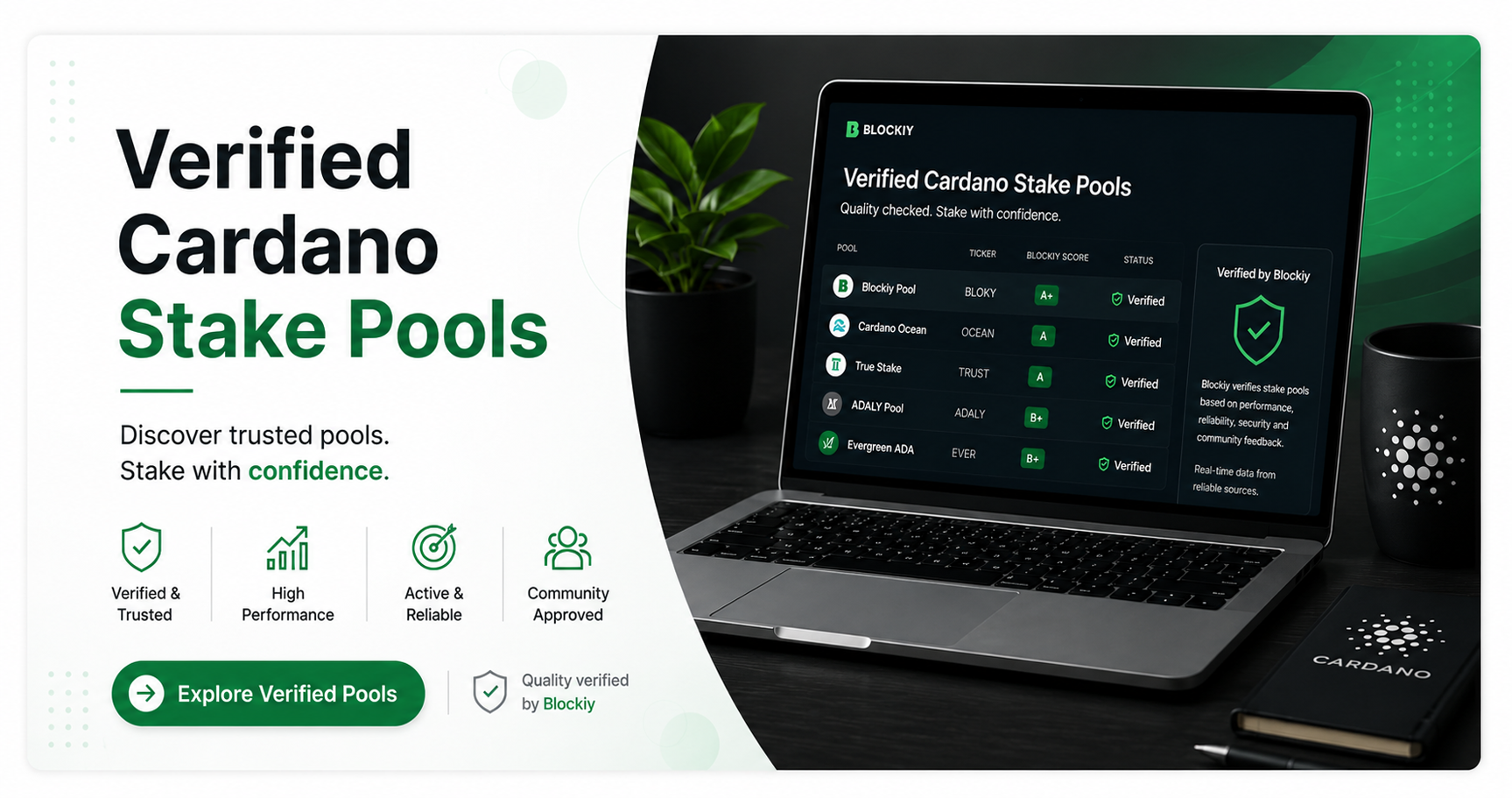
If you are switching because your current pool has become unreliable or saturated, compare more than its advertised margin. Look at block production, fees, pledge, saturation and operating history. The Cardano Verified Pools | Find Trusted Stake Pools For ADA Staking list can help you review verified pool options before making a new delegation choice. Verification is a starting point for comparison, not a guarantee of a particular reward.
The key point for your existing balance is simple: switching pools does not forfeit accumulated rewards.
What If Your Pool Stops Producing Blocks or Retires?
Rewards that have already been distributed to your reward account remain associated with your stake credential. A pool operator cannot withdraw those delegator rewards on your behalf.
The effect on future rewards is different. A pool that misses its block opportunities may earn less. A retired pool cannot continue serving as an active pool for new staking rewards. Check the pool’s status and redelegate to an active pool if necessary.
Because of snapshot and payout delays, you may still see a final reward tied to an earlier epoch. Conversely, a displayed estimate of future rewards is not the same as ADA already credited to your reward account.
That distinction—distributed balance versus projected or pending reward—is essential when diagnosing a pool shutdown.
What If You Move All Your ADA to a New Wallet?
Moving the ADA from one wallet’s payment addresses to a different wallet does not automatically move the first wallet’s accumulated reward-account balance. A payment transfer moves the outputs included in that transaction. The old wallet’s stake credential and reward account are separate parts of the picture.
Suppose your old wallet has 2,000 ADA in payment addresses and 25 ADA in unwithdrawn rewards. You send the 2,000 ADA, minus the relevant transaction fee, to a newly created wallet. The 25 ADA does not automatically follow just because the payment addresses are now empty. You still need access to the old stake credential to withdraw it. Additional delayed rewards may also arrive there from earlier epochs.
Before abandoning the old wallet:
- Check its current reward-account balance and whether more rewards from earlier epochs may still arrive.
- Make sure you can authorize a reward withdrawal with the old wallet or hardware device.
- Withdraw remaining rewards and transfer the spendable ADA as needed.
- Deregister the old stake credential only when you intend to close it, accounting for any final rewards and the registration deposit.
Keep a small amount of spendable ADA in the old wallet if a later transaction will need fees. A wallet holding only a reward-account balance may require additional spendable ADA or suitable transaction inputs to complete a withdrawal.
What If You Restore the Same Wallet in Another App?
Restoring the same wallet credentials in a compatible application is different from transferring ADA to a newly created wallet. If the restored application derives the same stake credential, the on-chain reward account and its history remain associated with it.
An empty or incorrect reward display after restoration can result from synchronization problems, a different account or derivation path, or limited support in the new application. Confirm the stake address and registration status before concluding the rewards are gone.
For a hardware wallet, keep the device and its recovery backup secure. A software wallet’s difficulty displaying the balance does not authorize anyone from “support” to request your recovery phrase.
Can You Withdraw Rewards Whenever You Want?
Once rewards have been distributed, a withdrawal is normally available whenever you submit a valid transaction and meet the stake credential’s current requirements. There is no need to wait for a special monthly claiming window.
There is a governance requirement that many older staking guides miss: to withdraw staking rewards, your stake credential must also have an active vote delegation. That can be a delegation to a DRep or a built-in choice such as Abstain or No Confidence. Pool delegation and vote delegation are separate choices.
If your wallet reports that a reward withdrawal is blocked, check its governance or voting delegation settings. The rewards can continue to accrue even when you have not yet made the vote-delegation choice needed to withdraw them.
A supported wallet may guide you through this step or combine certificates in a transaction. Read the details on the signing screen, including fees and the selected governance option.
How Do You Withdraw Unclaimed ADA Rewards?
The exact buttons differ by wallet, but the underlying steps are similar:
- Open your wallet’s Staking, Rewards or Delegation section and confirm the available reward balance.
- Check that your wallet has an active vote delegation if the withdrawal flow requires one.
- Choose Withdraw, Claim or the wallet’s equivalent action.
- Review the transaction fee, destination or change address, and any additional certificates before signing.
- Sign with the credentials controlling the stake account. If you use a hardware wallet, approve the transaction on the device.
- Wait for on-chain inclusion, then check that the reward-account balance decreased and your spendable payment balance reflects the withdrawal, allowing for fees and any other transaction effects.
A reward withdrawal is an on-chain action. Closing your browser after clicking the button does not prove it completed. Check the transaction ID if the wallet remains stuck on “pending.”
Do not enter a recovery phrase into a website offering to “release expired ADA rewards.” Ordinary staking rewards do not require a third party to unlock them.
What Happens If You Stop Delegating?
“Stop staking” can mean different things in different wallet interfaces. It might mean switching pools, moving your payment balance, changing a delegation choice, or deregistering the stake credential altogether. Those actions have different effects.
Moving your ADA out may reduce future rewards once the relevant snapshots catch up, while previously credited rewards remain in the old reward account. A wallet action that actually deregisters the stake credential is more consequential: withdraw its rewards before or as part of deregistration.
If you are reclaiming the stake registration deposit, inspect the transaction for both the reward withdrawal and the deposit refund. Do not assume a button labeled “Undelegate” handles every part of account closure correctly without reviewing the details.
If final rewards from prior epochs are still expected, plan the closure around that timing. The safest approach is to check the actual reward history and account state rather than relying only on a countdown shown by the wallet.
What If Your Wallet Shows Zero Rewards?
“Zero” can mean no reward was ever earned, a reward has not been distributed yet, the rewards were already withdrawn, or the application is showing the wrong account or stale data.
Work through the possibilities in this order:
- Check the reward address. Are you viewing the same stake credential you originally registered and delegated?
- Check timing. Has your stake had time to become active and pass through a full reward cycle?
- Check pool activity. Did the delegated pool produce blocks in the relevant earning epochs, and was it active?
- Check withdrawal history. Some wallets automatically include a reward withdrawal in a different transaction.
- Compare an independent view of the stake address. A wallet display can lag or fail even when the on-chain account is correct.
- Check the account type. ADA held at an exchange follows the exchange’s own staking and payout terms; you may not control an individual on-chain reward account there.
If a pool earned no delegator rewards for an epoch, there may simply be no new amount to claim for that period. An estimated annual percentage shown in an app is not a promise of an epoch-by-epoch payout.
Are Exchange “Unclaimed Rewards” the Same Thing?
Not necessarily. On a centralized exchange, the exchange typically controls the on-chain wallets and offers you a service under its own terms. An “unclaimed rewards” figure in your exchange account may be an internal accounting entry, subject to that platform’s payout schedule, eligibility rules and withdrawal procedures.
The self-custody behavior described in this article applies when you control the Cardano stake credential associated with the reward account. If an exchange or custodial platform holds your ADA, check that platform’s specific rules before assuming on-chain reward-account behavior applies to your account balance.
Frequently Asked Questions
Can a stake pool operator keep my rewards if I never claim them?
No. Rewards already distributed to your own stake credential are not a pool operator’s balance. An operator’s fees and margin are handled during reward calculation, before your portion is credited.
Do I lose compounding if I leave rewards unwithdrawn?
No. With an active delegation, rewards in your reward account count toward delegated stake through the normal snapshot cycle. Withdrawing them solely to restake is unnecessary.
Can I pay someone directly from my reward account?
An ordinary payment spends from payment-address outputs. First withdraw rewards into a spendable payment output, or use wallet functionality that combines the withdrawal with the payment in one valid transaction if supported.
Will unclaimed rewards from my old pool follow me when I redelegate?
The reward balance stays in your own reward account. It remains associated with your stake credential as your delegation changes. You do not need to withdraw it before switching pools.
Why can I see rewards but cannot withdraw them?
Check whether your stake credential has an active vote delegation, whether the wallet supports the required transaction and whether you have suitable spendable funds for the transaction fee. A displayed balance alone does not prove the wallet has built and submitted a valid withdrawal.
Is the stake registration deposit part of my rewards?
No. The deposit relates to registering your stake credential and is generally reclaimed through deregistration. Reward withdrawals and deposit refunds are different ledger actions, even if a wallet combines them in one transaction.
What is the one situation where leaving rewards untouched is risky?
Closing or deregistering the stake credential without handling its reward balance. Before you retire an old wallet’s staking account, withdraw the rewards, account for delayed payouts and check the transaction that reclaims the registration deposit.
Unclaimed ADA rewards are usually doing useful work already: they remain credited to your reward account and contribute to your delegated stake. Withdraw when you need to use the ADA, and treat closure of the stake credential as a deliberate final step.