Can I Switch Pools Without Unstaking or Losing My ADA?
You open your wallet, look at the pool you chose months ago, and wonder whether another one would be a better fit. Maybe your current pool is saturated. Maybe its rewards have been disappointing. Maybe you found a smaller pool with a mission you actually care about.
Then comes the question that keeps many people from making a change: if you switch, do you have to unstake first, move your ADA, or give up the rewards you have already earned?
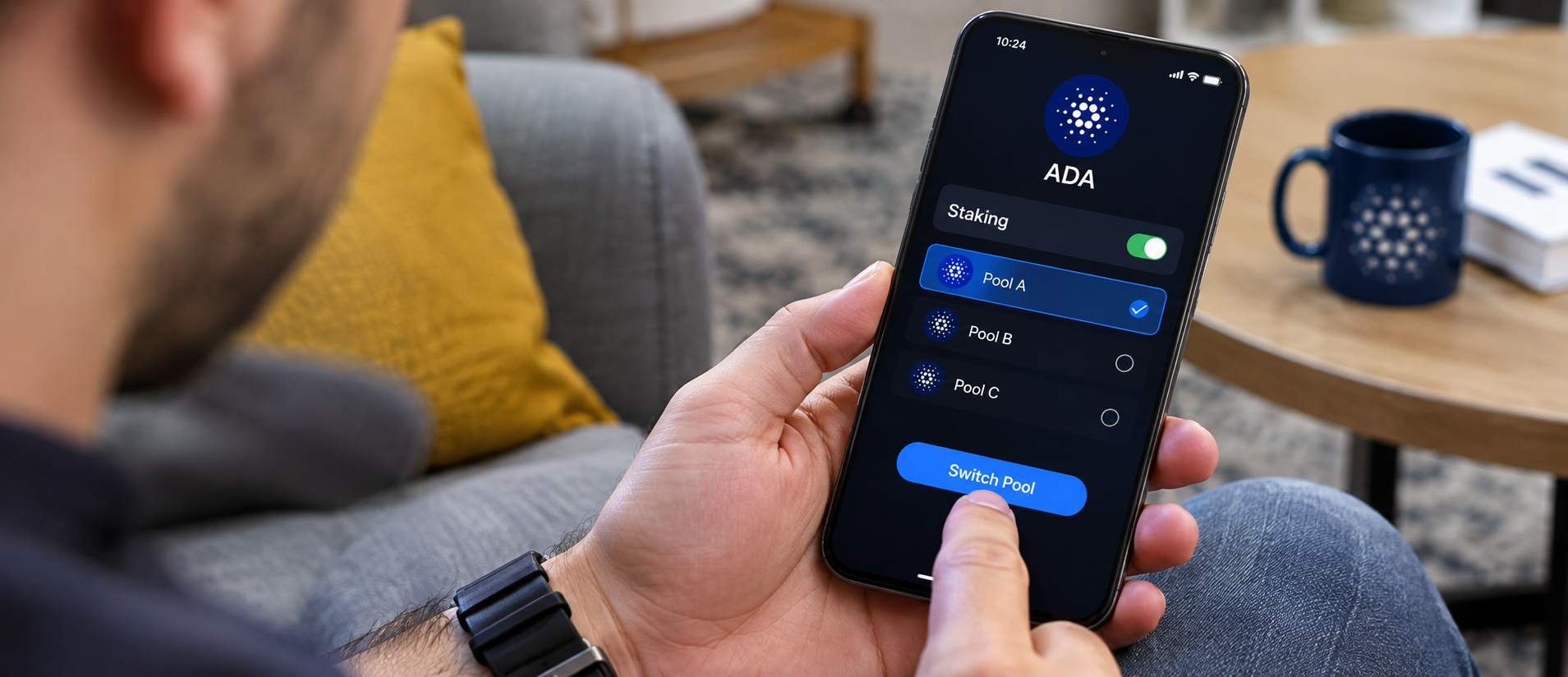
For ordinary self-custody staking on Cardano, the answer is reassuring: you can change pools directly. Your ADA remains in your wallet, and your earned ADA rewards remain yours. You pay a normal transaction fee to update your delegation, and the change takes effect according to Cardano’s epoch schedule. You do not have to withdraw your balance, cancel staking, or start again with a new wallet.
The details matter, though. A pool change does not instantly redirect your next reward payment. It is also different from moving ADA to a new wallet, withdrawing rewards, or using an exchange’s staking product. Here is what actually happens and how to make the switch safely.
What actually changes when you switch pools?
Cardano staking is a delegation choice associated with your wallet’s stake credential. Think of it as telling the network which pool should represent the staking power of the ADA controlled by that credential. When you choose another pool, your wallet submits a new delegation certificate through a normal Cardano transaction.
That transaction changes the pool assignment. It does not send your ADA to the pool operator.
| Item | After a normal pool switch |
|---|---|
| ADA in your wallet | Still controlled by your wallet and spendable |
| Wallet recovery phrase and signing keys | Unchanged; never share them with a pool |
| Previously earned ADA rewards | Still associated with your reward account |
| Your pool choice | Updated on-chain, then reflected in future stake snapshots |
| Your reward history | Old-pool rewards can continue arriving during the transition |
| Cost | A normal network transaction fee; no new stake-key deposit for an already registered stake key |
You can still send or receive ADA while delegated. If the amount in your wallet changes, future snapshots reflect the changed stake. Delegation is not a lock on your coins.
This guide describes native Cardano delegation from a self-custody wallet. If an exchange or custodial service holds your ADA, its withdrawal rules, fees, timing, and account interface may be different.
Do you need to unstake before choosing a new pool?
No. If you are already delegated, open your wallet’s staking section, find the new pool, and submit a redelegation transaction. You do not need a separate “unstake” transaction first.
In some wallets, the button says Delegate even though you are already staking. In others, it says Change pool or Redelegate. The label varies. What matters is the transaction you are authorizing: it should update your stake delegation to the intended pool, not transfer your wallet balance to an unfamiliar address.
Avoid deregistering your stake key merely to change pools. Deregistration is a different action that ends the stake-key registration and can return its refundable deposit when the required conditions are met. For a routine switch, it adds unnecessary complexity. An already registered stake credential can simply be delegated to another pool.
Will you lose ADA or previously earned rewards?
Switching pools does not expose your staked principal to a protocol penalty. Cardano does not slash a delegator’s ADA because a pool performs badly. The ADA you hold is still yours. ADA rewards already credited to your reward account also stay there; you do not have to withdraw them before changing pools.
There are three separate things people often lump together as “losing rewards”:
- A transaction fee: You spend a small amount of ADA to submit the new delegation. This is a real cost, but it is not a staking penalty.
- Future rewards depend on pool performance: A pool that misses assigned blocks, fails to meet its declared pledge, or produces no blocks in a particular epoch may yield less or nothing for that epoch. Small pools can have uneven results even when operating correctly.
- The new pool’s rewards arrive later: Because the network uses snapshots, seeing old-pool rewards after the switch is normal. It does not mean your transaction failed.
If your wallet shows a lower spendable balance than its total ADA balance, check whether it presents the reward account separately. A difference in display is not evidence that a pool took your coins. Review the transaction, payment balance, and reward balance separately.
The timeline: why the old pool still pays after you switch
Cardano divides time into epochs of roughly five days. Your new pool choice is recorded on-chain when the transaction confirms, but stake snapshots and reward accounting work on a delayed schedule.
Suppose you are delegated to Pool A and switch to Pool B during epoch N:
| When | What happens |
|---|---|
| Epoch N | You submit the redelegation transaction. Your wallet may immediately show Pool B as your selected pool. |
| Start of N+1 | A snapshot captures your stake with the new delegation choice for a future active epoch. |
| Epoch N+2 | The new snapshot becomes active. Pool B now represents your stake for block production and reward calculation. |
| Starts of N+1, N+2, and N+3 | You can still receive payouts attributable to Pool A’s earlier active epochs, if it earned rewards. |
| Start of N+4 | The first payout attributable to Pool B’s active epoch may arrive, if Pool B earned rewards. |
The new pool becomes active before its first reward payment reaches your wallet. Three old-pool payouts followed by the new pool’s fourth payout are part of the normal pipeline. If either pool had an epoch with no distributable rewards, a particular payment can be zero. The protocol does not guarantee a positive payment every epoch.
The number of calendar days you wait depends on when in an epoch you submit the transaction. Do not judge a switch by whether your next reward line still names the old pool. Instead, check the confirmed delegation transaction, the relevant stake snapshot, and the reward epoch shown by your wallet or a block explorer.
How to switch pools safely
Wallet screens change, but the underlying checks are consistent. You can follow this process in a self-custody Cardano wallet that supports delegation.
1. Record your current pool details
Before changing anything, note your current pool’s ticker and pool ID, your wallet’s stake address if displayed, and the current epoch.
A ticker is a short name, not a unique security guarantee. Use the full pool ID when you need to distinguish pools with similar names. Check whether your existing pool is retired, oversaturated, or simply having a quiet run of blocks.
2. Compare the new pool on more than one metric
Look at its current and recent active stake, saturation, fixed cost, margin, declared pledge, block production over a meaningful period, and whether the operator communicates clearly.
A pool with 0% margin is not automatically the highest-return pool; fixed costs and produced blocks matter too. A small pool with no block in one epoch is not automatically broken. Its rewards can be less frequent and more variable because block assignment is probabilistic.
If you are considering extra token incentives, separate on-chain ADA staking rewards from pool-run promotional rewards. The network distributes ADA according to its staking rules. A bonus-token program has its own eligibility conditions, snapshots, payment schedule, and risks. A calculator can estimate an offer, but it cannot promise future ADA performance or the market value of bonus tokens.
For example, if you are comparing a Blockiy-supported pool with your current one, use the Blockiy Airdrop Calculator | NIGHT, SNEK & HOSKY to explore the projected token amounts for your ADA balance. Then check the program’s current eligibility and payment conditions before switching. The calculator helps you compare options; it is not proof that rewards have already accrued to your address.
3. Select the pool inside your wallet
Open the wallet’s staking section and search for the target pool. Check its full pool ID against an independent explorer or the pool’s official page.
Make sure you are using the intended wallet account. People with multiple Cardano accounts can have different stake credentials and different pool choices.
4. Review the transaction before signing
The request should be a delegation change plus a network fee. If your stake key was already registered, an additional first-time stake-key deposit should not be necessary for that same credential. A new wallet account or a different stake credential may have its own registration and deposit requirements; that is a different situation.
Be especially careful if a site asks you to send ADA to a deposit address, enter your recovery phrase, reveal your hardware wallet seed, or approve an unrelated token transfer to “switch pools.” None of those is required for ordinary redelegation. On a hardware wallet, review the operation on the device itself rather than trusting only the computer screen.
5. Confirm the new delegation on-chain
After the transaction confirms, save its transaction ID. Check your wallet’s selected pool and, when available, look up your public stake address on a Cardano explorer to verify the delegated pool ID.
Some services show the new choice promptly while their active stake and rewards views still reflect older snapshots. Those screens answer different questions.
6. Watch the correct epochs, not just the next payment
For the next several epochs, note which epoch each payout belongs to. Expect the old pool to appear in the reward pipeline. Check the new pool’s active stake and later reward history before concluding something has gone wrong.
If a promotional program requires separate address registration, complete that step according to the program’s instructions. On-chain redelegation alone may not enroll you in a separate bonus-token program.
When does switching actually make sense?
Changing pools is easy, but doing it after every disappointing epoch is rarely a good decision. The useful question is whether the evidence for moving is stronger than normal reward variation.
A switch is worth serious consideration when:
- Your current pool is retired or has announced an upcoming retirement.
- It has been persistently oversaturated, affecting its reward prospects.
- The operator repeatedly misses expected blocks or has a sustained availability problem, after allowing for the pool’s size and chance.
- Its fees or pledge changed in a way you no longer accept.
- You have checked another pool’s incentive terms and prefer its combined offer and operating record.
- You want to support a smaller, well-run pool and understand that its payouts may vary more from epoch to epoch.
Pause and investigate when:
- Your only evidence is one zero-reward epoch from a small pool.
- A dashboard shows a low performance percentage for an epoch that has not ended.
- You are tempted by a headline yield without a clear explanation of its assumptions.
- A promotional offer asks for private keys or promises guaranteed returns.
Consider a simple case. Pool A has had one unlucky epoch but otherwise produces roughly the blocks expected for its stake. Pool B advertises “more rewards” but publishes no clear reward history or token distribution rules. That is not enough evidence to move.
On the other hand, if Pool A is consistently saturated or retiring and Pool B has transparent fees, credible operations, and terms you understand, switching may be entirely reasonable.
Five mistakes that create unnecessary worry
1. Withdrawing your ADA to “unstake”
Moving funds to an exchange, another wallet, or a fresh address is not part of changing pools. A normal redelegation leaves the ADA where it is. A transfer may create avoidable fees or change which stake credential controls the funds.
2. Mistaking a reward delay for a missing reward
Rewards are calculated from past active stake, not from the pool name shown right now in your wallet. Check the epoch associated with a payment before raising an alarm.
3. Paying a stake-key deposit twice without understanding why
The refundable deposit applies when a stake credential is registered. Selecting another pool with the same registered credential should require the normal transaction fee, not a fresh stake-key registration deposit. If your wallet shows one, check whether you selected a different account.
4. Treating bonus tokens as guaranteed ADA yield
ADA rewards and an operator’s NIGHT, SNEK, or HOSKY distribution are different systems. Bonus-token terms can depend on minimum stake, registration, epoch snapshots, available program funding, and payment administration. Token prices can move sharply. Assess each part separately.
5. Confusing staking delegation with governance delegation
Your stake pool choice determines which pool represents your stake for block production. Your governance delegation determines who represents your voting power, or whether you choose an available governance option such as abstain.
Changing pools does not automatically select a new DRep. If you cannot withdraw accumulated rewards, check the status of your governance delegation as well as your wallet’s staking settings.
Frequently asked questions
Can I switch pools in the middle of an epoch?
Yes. You can submit a redelegation during an epoch. Snapshot timing determines when the new choice becomes active; the transaction does not rewrite an earlier snapshot.
Is there a minimum ADA balance required to change pools?
The protocol does not impose a special minimum stake for changing pools, but your wallet needs enough ADA to pay the transaction fee. Separate incentive programs may have their own minimum balance requirements.
Will my unclaimed ADA rewards disappear?
No. Rewards already credited to your reward account remain associated with your stake credential. You generally do not need to withdraw them to change pools. Withdrawal can require a valid governance delegation, which is separate from switching stake pools.
Can I switch pools repeatedly?
You can update your delegation again, but each on-chain change has a fee and follows snapshot timing. Frequent switching makes performance comparisons harder and may affect eligibility for pool-specific incentives. Check the current pool assignment and program terms before submitting another transaction.
Will ADA added after a pool switch count automatically?
For ADA controlled by the same delegated stake credential, the updated balance is reflected in subsequent snapshots. You normally do not submit another pool delegation merely because you received more ADA. Check the wallet account if you use multiple stake credentials.
Does switching pools change my wallet address?
No new payment address is required for a routine switch. Wallets may generate multiple receiving addresses, but changing pool delegation does not require you to replace your wallet or share its recovery phrase.
What if my old pool retires before I move?
Your ADA remains in your wallet. A retiring pool can stop producing future rewards for your delegated stake once retirement takes effect. Choose an active pool and confirm your new delegation promptly; any already earned rewards follow the normal accounting schedule.
Are rewards guaranteed to be continuous and equal?
The delegation pipeline avoids a forced gap caused solely by changing pools. It does not guarantee that every epoch yields a positive amount or that old and new pools pay the same. Pool performance, active stake, pledge, fees, and chance all affect results.
The takeaway
You do not need to unstake to change a Cardano stake pool. Choose the new pool, verify its identity and terms, sign a standard redelegation transaction, and let the epoch snapshots do their work. Your ADA stays in your wallet. Your earned ADA rewards remain yours.
Expect old-pool payouts during the transition. Judge the new pool after your stake has become active there and its rewards have had time to arrive. Compare the mechanics you can verify, understand any separate token incentives, and make the change for a reason that will still make sense after a single unlucky epoch.