Cardano Pool Fees: Fixed Cost vs. Margin Explained
Two Cardano stake pools both advertise a 0% margin. One can still leave less for delegators than the other. The number missing from that comparison is the fixed cost, an ADA amount the protocol accounts for before it applies the pool’s percentage cut.
What is a stake pool’s fixed cost?
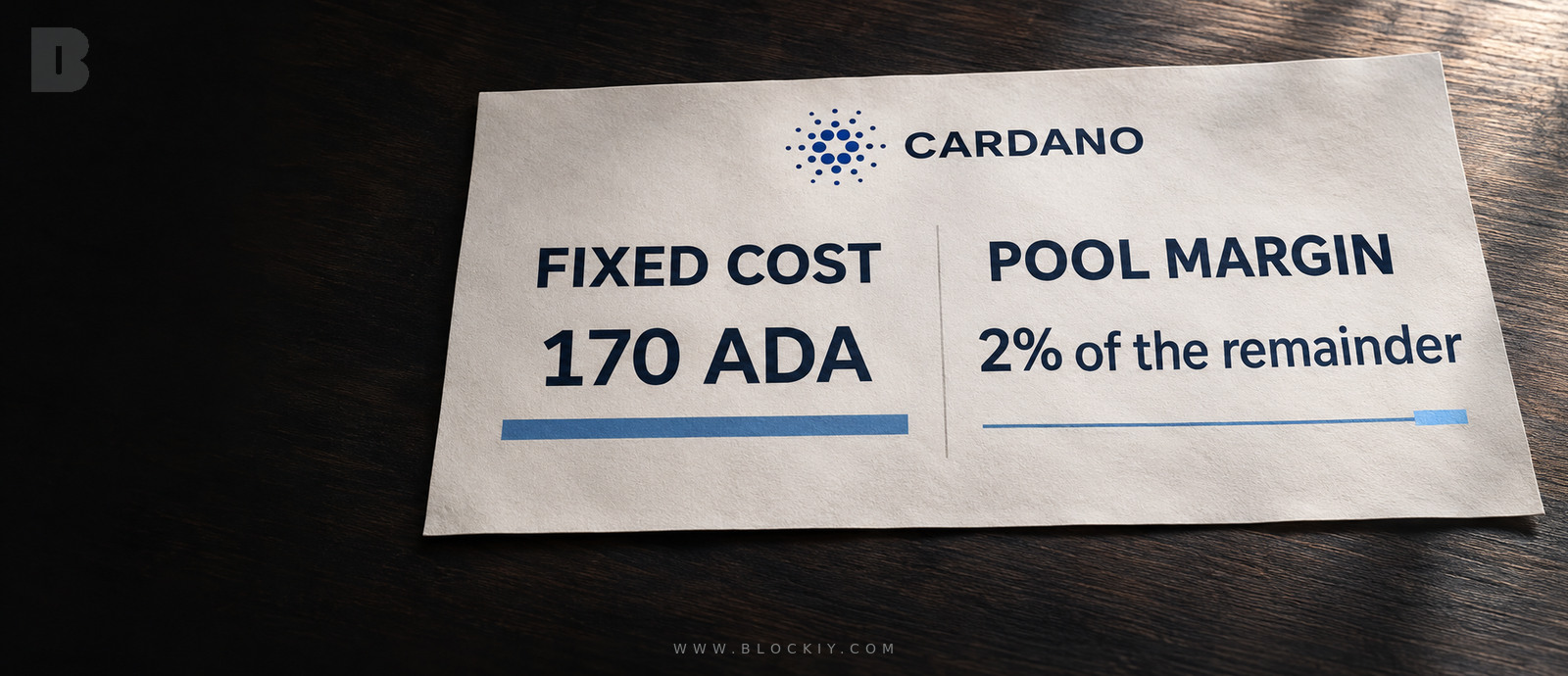
The fixed cost is the amount in ADA a pool registers to retain from its rewards for an epoch. As of November 25, 2026, Cardano mainnet’s minimum, called minPoolCost, is 170 ADA. A pool can register a higher amount. The minimum is a rule for the pool’s registered cost, not a promise that the operator will receive 170 ADA every epoch.
If the pool earns no reward in an epoch, there is nothing to deduct. If the gross reward is 120 ADA and the fixed cost is 170 ADA, the operator receives at most the 120 ADA available; there is no remainder for margin or the stake-based split. No shortfall is billed to delegators or carried into a later epoch. The fixed cost is applied at the epoch level, not once per block.
What is a stake pool’s margin?
The margin is the percentage the pool operator takes after the fixed cost. A 2% margin is not 2% of your wallet balance, and it is not a two-percentage-point reduction in annual staking yield. A 0% margin simply means the pool takes no additional percentage cut after the fixed cost.
After the fixed cost and margin, the remainder is split according to the eligible stake in the reward snapshot, including the owners’ eligible stake. That reward share on owner stake is separate from the operator’s fixed cost and margin.
Worked example: an epoch with 1,000 ADA in pool rewards
Suppose a pool has a 170 ADA fixed cost and a 2% margin. After the fixed cost, 830 ADA remains. The margin is 2% of 830 ADA, or 16.60 ADA. That leaves 813.40 ADA for the stake-based split. If your stake represents 1% of the eligible total, your share is about 8.134 ADA, before any ledger rounding. This is an illustration, not an estimate of a particular pool’s rewards.
| Epoch reward | Fixed cost paid | 2% margin | Left to split |
|---|---|---|---|
| 0 ADA | 0 ADA | 0 ADA | 0 ADA |
| 120 ADA | 120 ADA | 0 ADA | 0 ADA |
| 300 ADA | 170 ADA | 2.60 ADA | 127.40 ADA |
| 1,000 ADA | 170 ADA | 16.60 ADA | 813.40 ADA |
In the 300 ADA example, the fixed cost alone uses about 57% of the gross reward; in the 1,000 ADA example it uses 17%. That is why the same registered fees can feel very different in two epochs. A pool that produces blocks infrequently also needs to be judged over more than one epoch.
Can a 0% pool leave less for delegators?
Yes. With an identical gross reward of 1,000 ADA, a pool charging 340 ADA + 0% leaves 660 ADA to split. A pool charging 170 ADA + 2% leaves 813.40 ADA. This isolates the fee effect; it does not show which pool will produce more blocks or which will reward your wallet more across different epochs.
- Read both fee fields. Look for Fixed Cost and Margin on the pool record. Don’t confuse fixed cost with a transaction fee.
- Look at several epochs. Compare block production and rewards over time, not just the most recent payout or a brief annualized figure.
- Check the denominator. Active stake affects both block opportunities and the stake-based split. Also look at saturation and whether the declared pledge is met.
What would a minimum margin change?
The November 2026 discussion about minMargin concerns a possible floor for the percentage a pool can set. That is different from lowering minPoolCost, which changes the floor for the fixed ADA amount. A fixed cut takes a larger proportion of a small reward than a large one; a percentage cut scales with the reward base to which it is applied.
As of November 25, a discussion about a minimum margin is not an enacted minimum percentage. The proposed reduction of the minimum fixed cost to 75 ADA did not take effect. A 0% pool margin is therefore not, by itself, outdated or invalid. If Cardano adopts a new floor later, the enacted settings, not a workshop or proposal headline, will determine what changes for operators and delegators.