
Cardano Businesses Can Now Issue Their Own Dollar Stablecoins
Brale added Cardano to its stablecoin platform on November 24, 2026. The integration is live on mainnet and testnet through Brale's app and API. Eligible businesses can use it to issue a branded, dollar-backed stablecoin on Cardano or use supported stablecoins for payments, payouts and treasury operations. The announcement is about an issuance service going live. It does not identify a new Cardano stablecoin that readers can buy or redeem today.
What Brale handles
A business that wants its own stablecoin needs more than a token name and a minting policy. It needs a way to receive dollars, hold reserves, issue and redeem tokens, and move money between bank accounts and wallets. Brale provides that infrastructure. Cardano records the issuance and transfers on-chain, while the dollars backing the tokens and the terms for getting those dollars back sit outside the ledger.
A branded token can make sense when a business needs specific transfer rules or wants a balance that operates inside its own product. If the job is simply to pay vendors in dollars, a supported stablecoin that those vendors already know how to receive and redeem may be easier. Launching a separate token means taking on the work of explaining it, integrating it and giving people a reliable way to get out of it.
What CIP-113 changes
Brale's integration uses CIP-113, a Cardano specification for programmable tokens. An ordinary Cardano native token can move after it is minted without running a token-specific transfer check. A programmable token can require an additional check when it changes hands. For example, a token could be configured to transfer only between approved wallets. The restriction would still apply outside the issuer's app because it is checked on-chain.
That is an example of what the design supports, not a claim that every Brale-issued token has the same rules. The exact controls depend on how each token is configured. The public CIP still lists its status as Proposed, even though an implementation is already in use on mainnet. The integration did not change how ADA or existing Cardano tokens transfer.
A transaction record can tell you that a transfer was recorded. It cannot show the balance in an issuer's bank account. To see how Cardano groups transactions into blocks, you can browse recent block activity below. The tool does not track stablecoin reserves or redemption status. Open Live Cardano Pool Blocks
What a payout could look like
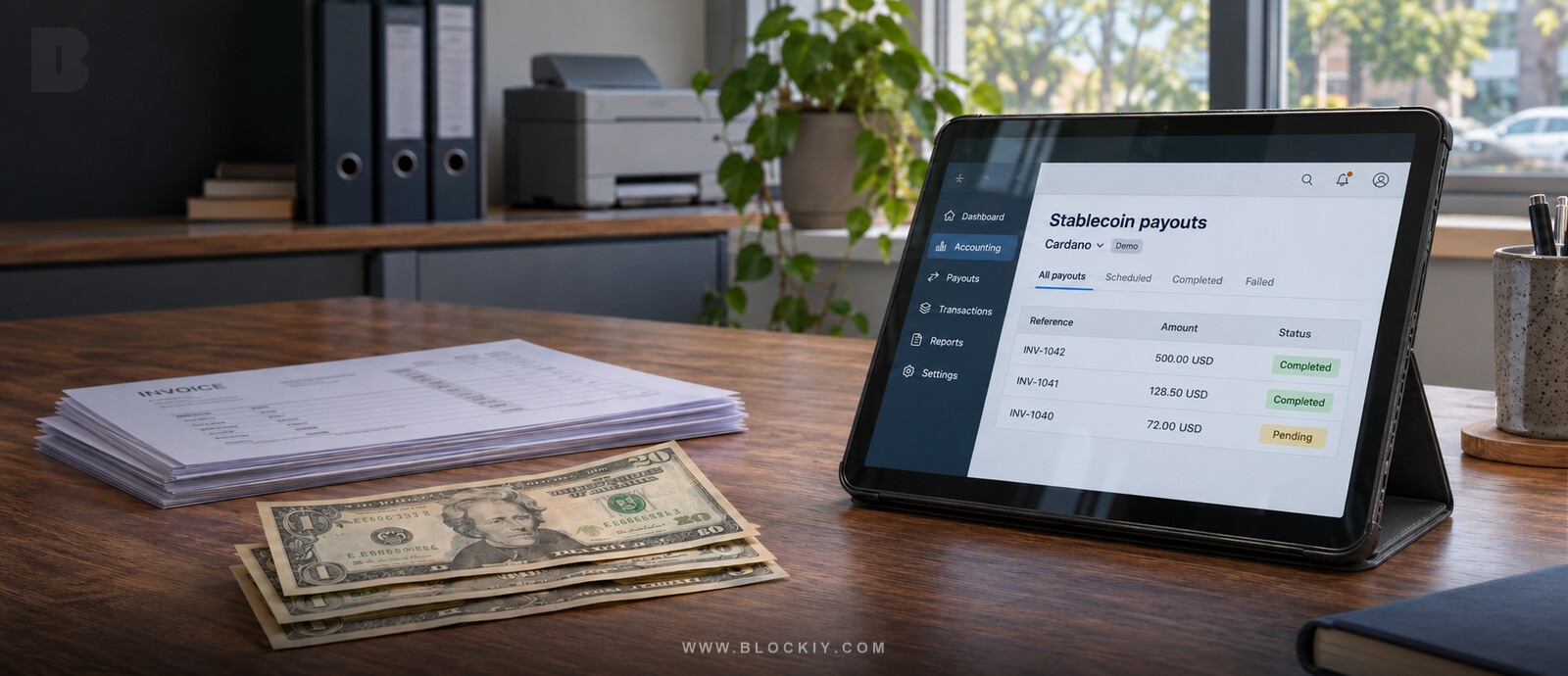
Imagine a marketplace owes a seller $500. In a hypothetical approved setup, it could fund 500 units of a dollar-backed token and send them to the seller's compatible Cardano wallet. If the token requires an approved receiving wallet, that check must pass before the transfer can complete. If it fails, the seller does not receive the token just because the marketplace approved the invoice.
The marketplace still has to reconcile the invoice, the on-chain payment and any fees. If the seller wants dollars in a bank account rather than a token in a wallet, redemption is a separate step, subject to the issuer's terms and eligibility. A confirmed on-chain payment does not mean the bank payout has already cleared.
What to check before using a new token
- Identify the exact asset. Check the network, asset name and policy ID against the issuer's information. A ticker or logo is not proof of identity.
- Read the redemption terms and reserve report. Find out who can redeem, any minimums and fees, when bank settlement occurs, and whether the reserve report covers that specific asset. An attestation is evidence for the period or date it covers, not a guarantee of future liquidity.
- Test the recipient's actual setup. Confirm that the wallet or application supports the token and that any recipient restrictions are satisfied. Test a small end-to-end payment before moving a larger balance.
- Check each route separately. Support for multiple blockchains does not mean every token is available on every chain or compatible with every wallet, exchange or DeFi app. Verify the exact asset, network and exit route you intend to use.
The next meaningful milestone is a named issuer with a verified Cardano policy ID, clear redemption terms and repeat usage. Brale's launch makes those deployments possible. It is not, by itself, evidence of new liquidity or adoption.